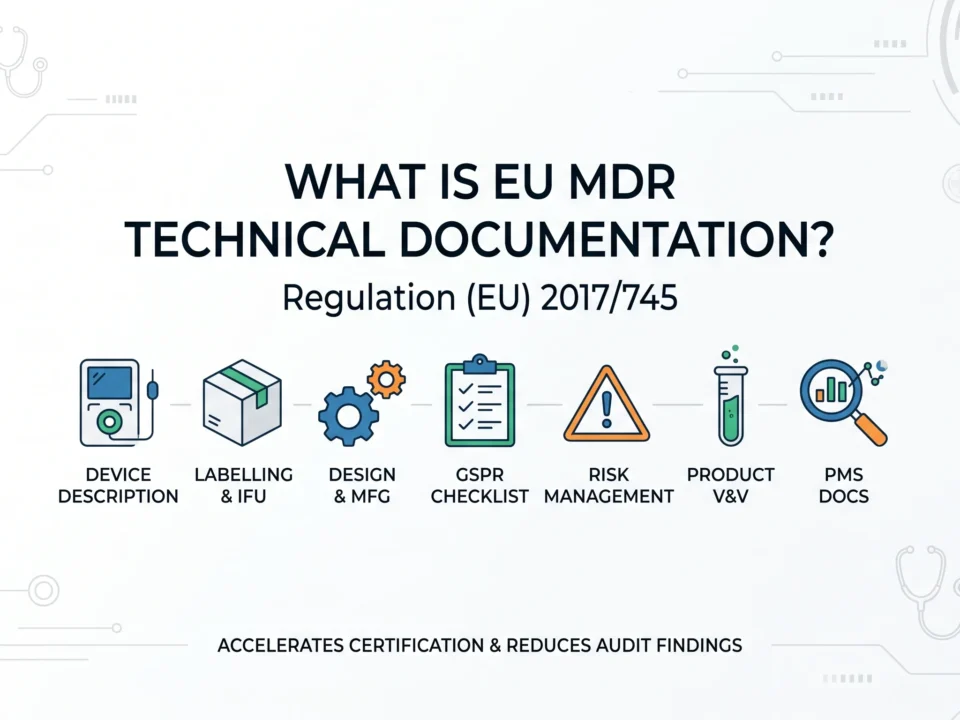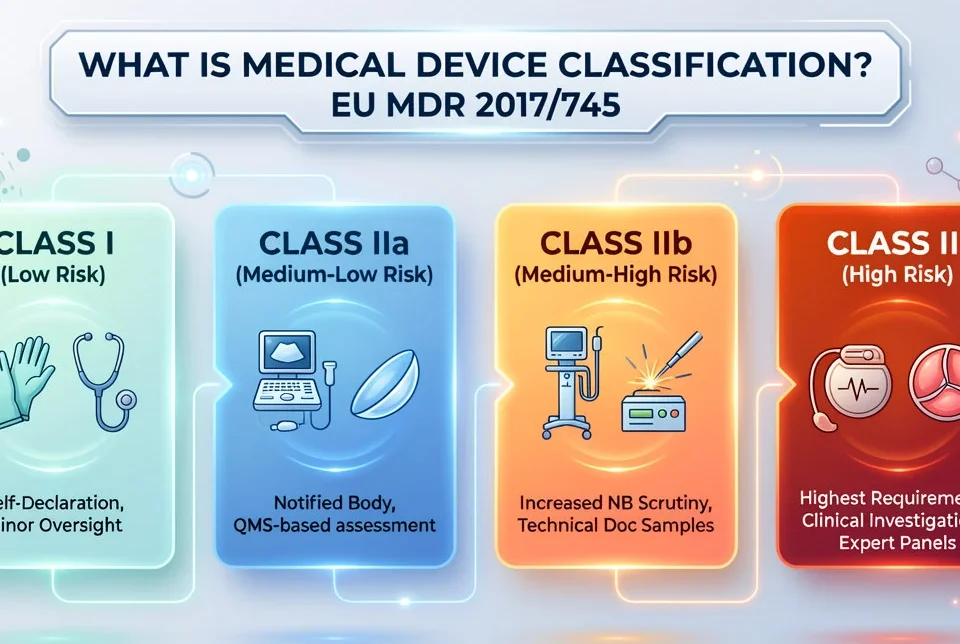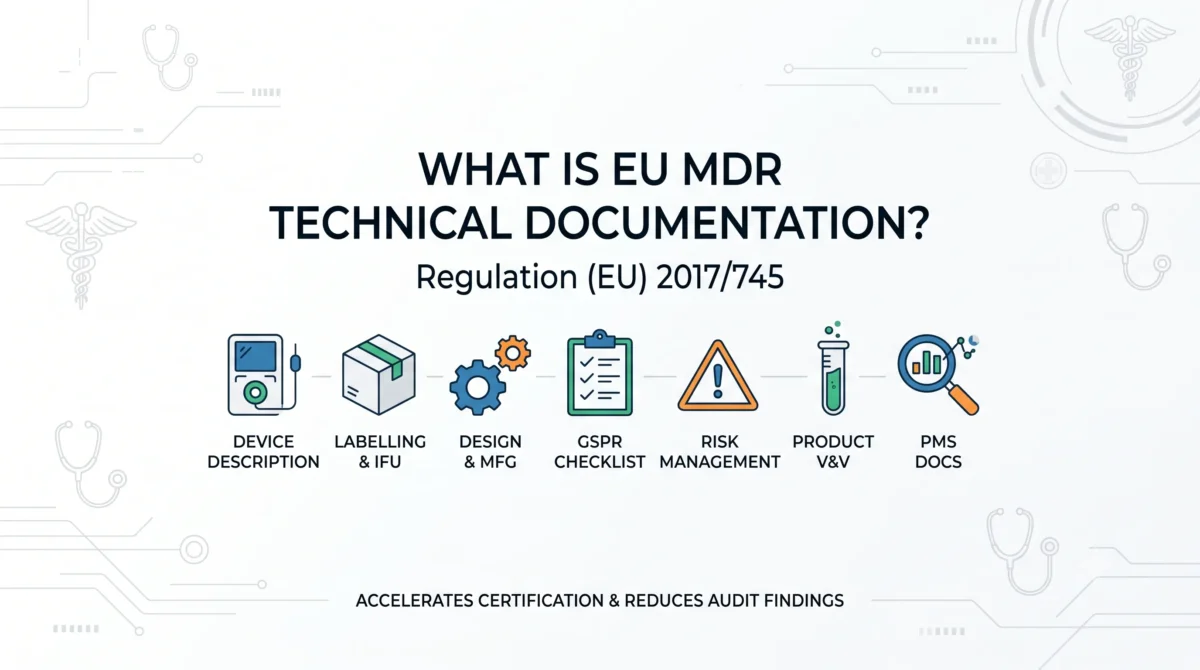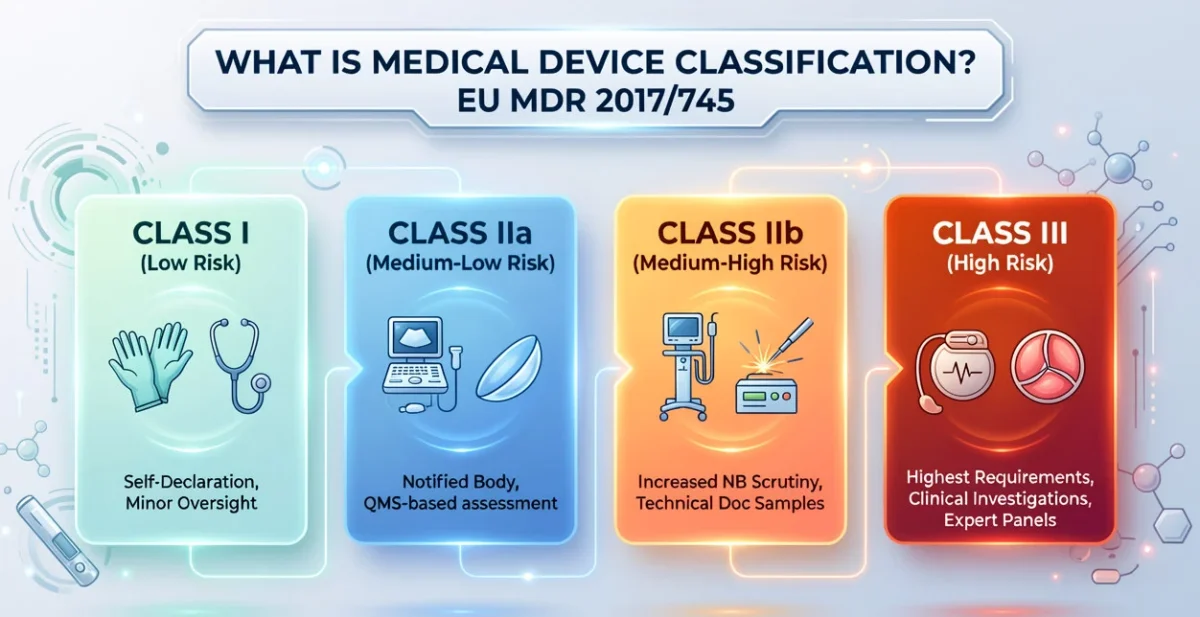

What Are the Labeling and IFU Requirements Under EU MDR?
Labeling and IFU Requirements Under EU MDR are defined in Section 23 of Annex I of Regulation (EU) 2017/745 — specifically sub-sections 23.2 (label) and 23.4 (instructions for use). These requirements specify what information medical device manufacturers must provide on the device label, packaging, and instructions for use (IFU). Compliance with these requirements is mandatory for CE marking and is one of the most frequently cited areas of non-conformity during Notified Body audits.
The labeling and IFU requirements apply to all medical devices, regardless of risk class. The level of detail and the number of required elements increase with device complexity and risk. For an overview of the full MDR framework, read the EU MDR Compliance Complete Guide.
Regulatory Basis
Annex I Section 23.2, Information on the Label
Section 23.2 specifies information that must appear on the device label. The label must be supplied with each device unit or its packaging.
Annex I Section 23.4, Information in the Instructions for Use
Section 23.4 specifies information that must appear in the IFU. The IFU must accompany each device unit unless an exception applies.
Device Label Requirements (Section 23.2)
The label must bear all of the following information:
- Device name or trade name: As defined by the manufacturer and consistent across regulatory documentation
- Essential information: Details necessary for the user to identify the device, its intended purpose, and contents
- Manufacturer name and address: Registered business address, matching the EUDAMED actor registration
- SRN: Single Registration Number of the manufacturer (format: Country Code-MF-000000000, e.g., DE-MF-000000000)
- Authorized Representative: If the manufacturer is outside the EU (excluding countries with specific Customs Union agreements like Turkey, which do not require an AR), the AR name and address, including SRN (format XX-AR-000000000)
- UDI carrier: UDI-DI and UDI-PI on label and packaging levels per Annex VI Part C
- Batch code or serial number: Identifies the specific production batch (lot) or device serial number
- Date of manufacture: Clearly indicated as year and month
- Use-by date: For devices with an expiry date, in the format YYYY-MM-DD
- Sterilization indication: If supplied sterile, the sterilization method and sterile packaging indication
- Single use indication: If intended for single use, the symbol per ISO 15223-1
- Storage and handling conditions: Temperature range, humidity, pressure, light sensitivity
- Special operating conditions: Any warnings, precautions, or contraindications necessary for safe use
- CMR or endocrine-disrupting substances: If the device contains CMR or endocrine-disrupting substances, identification of those substances per Section 10.6
- Human blood or plasma derivative: If the device incorporates human blood or plasma derivatives, an indication of this
- Annex XVI designation: For devices without an intended medical purpose per Annex XVI, an indication that the product is a medical device
Label Format Requirements
- Language: Labels must be in the official language(s) of the member state where the device is sold
- Readability: Text must be legible, durable (resistant to environmental factors and intended processing, such as sterilization), and appropriate for the intended user (healthcare professional or lay person)
- Symbols: Standardised symbols per ISO 15223-1 may replace text where recognised
Instructions for Use Requirements (Section 23.4)
The IFU must include all information necessary for the safe and effective use of the device. The MDR requires significantly more IFU content than the MDD.
IFU Content Requirements
- Device identification: Name, model, Basic UDI-DI, manufacturer, AR, and SRN
- Intended purpose: The medical indication, target patient population, anatomical site, and intended user
- Clinical benefits: Expected clinical benefits supported by the clinical evaluation
- Contraindications: Conditions under which the device must NOT be used
- Target population: Age, gender, weight, health status, and any subpopulation restrictions
- Intended user profile: Required training, qualifications, or experience
- Device description: Operating principle, mechanism of action, materials, dimensions
- Preparation before use: Installation, calibration, assembly, or configuration steps
- Operating instructions: Step-by-step instructions for normal use
- Special warnings and precautions: Residual risks, foreseeable misuse, and mitigation measures
- Adverse events and side effects: Known adverse events, frequency, and management
- Interactions: Known interactions with medicinal products, other devices, or substances
- Accessories: Required accessories and compatible devices
- Maintenance and calibration: Required activities, frequency, and procedures
- Cleaning, disinfection, sterilisation: Reprocessing instructions for reusable devices
- Disposal: Special disposal considerations, including electronic waste, batteries, or biological contamination
- Single-use or reuse limitation: Reuse restrictions with justification
- Shelf life: Expected service life and storage conditions
- Performance characteristics: Technical specifications, accuracy, sensitivity, specificity
- Residual risks summary: Overview of residual risks from the risk management file
- IFU date of issue and revision: Publication date and version number
- Manufacturer contact: Customer support and technical assistance contact information
Exceptions to Providing IFU
For certain class I and class IIa devices, the IFU may be omitted if the device can be used safely without written instructions. This exception applies when the device’s safe use is self-evident without such instructions. (Manufacturers must justify this in their risk management file per Annex I, Section 23.1(d)).
Electronic IFU (eIFU)
The MDR permits electronic IFU (eIFU) under Regulation (EU) 2021/2226 for devices intended for professional use. eIFU requirements:
- Website availability: eIFU must be accessible on a publicly available website
- Downloadable format: PDF or equivalent printable format
- Version control: Clear version identification and revision history
- Customer notification: Users must be informed when the eIFU is updated
UDI Carrier on Labels
The UDI carrier includes both:
- UDI-DI: Device identifier (static, identifies device model)
- UDI-PI: Production identifier (dynamic, batch/serial/expiry)
Placement Requirements (Annex VI Part C)
- The UDI carrier must appear on all label levels: device label, packaging, and shipping
- For reusable devices, the UDI carrier must be directly marked on the device itself (direct marking)
- AIDC (Automatic Identification and Data Capture) format, typically barcode or QR code
- HRI (Human Readable Interpretation), plain text alongside the machine-readable code
Symbols and ISO 15223-1
The MDR encourages the use of standardised symbols to reduce language burden. ISO 15223-1 defines symbols for medical device labelling. Common ISO 15223-1 symbols include:
- Single use: Symbol for intended single use
- Use-by date: Hourglass or calendar symbol
- Batch code: Symbol for lot/batch identification
- Catalogue number: Reference number symbol
- Sterile: Methods of sterilization (EtO, radiation, steam)
- Do not reuse: Prohibition symbol
- Keep away from sunlight: Environmental protection symbol
Symbols used without accompanying text must be defined in the IFU or on the label.
Implant Card (Article 18)
For implantable devices, the manufacturer must provide an implant card with the following information:
- Device identification: Name, type, Basic UDI-DI, serial number
- Manufacturer identification: Name, address, SRN, website
- Implant information: Date of implantation, surgical site
- Patient identification: Name, date of birth, or unique patient identifier
- Warnings and precautions: Known risks, MRI compatibility, expected service life
- Contact information: Manufacturer support contact for implant-related issues
Note: Article 18 includes specific exemptions. Sutures, staples, dental fillings, dental braces, tooth crowns, screws, wedges, plates, wires, pins, clips, and connectors are exempted from the implant card requirement.
Language Requirements
The MDR requires labeling and IFU in the official EU language(s) of each member state where the device is marketed. Member states specify their accepted languages in national legislation. Common requirements:
- Germany: German
- France: French
- Italy: Italian
- Spain: Spanish
- Netherlands: Dutch
- Poland: Polish
- All others: Respective national languages
Manufacturers should verify language requirements with each member state’s competent authority before market placement.
Common Labeling Non-Conformities
Notified Body label and IFU reviews consistently identify:
Missing or Incorrect SRN
The Single Registration Number must appear on the label. Many manufacturers omit the SRN or use an incorrect format.
Incomplete UDI Carrier
UDI-DI and UDI-PI must both appear on all label levels. Missing AIDC or HRI format elements are common findings.
Language Gaps
Labels and IFU not available in all required languages for the target member states. Some manufacturers provide only English IFU for non-English markets.
Insufficient IFU Content
IFU missing required elements specified in Section 23.4, particularly clinical benefits, residual risks summary, and adverse events information.
Outdated Symbols
Symbols not conforming to the latest ISO 15223-1 edition. The standard is updated periodically and manufacturers must ensure compliance.
Implant Card Missing
For implantable devices, the implant card per Article 18 is sometimes omitted or does not contain all required fields.
Summary
Labeling and IFU Requirements Under EU MDR as defined in Annex I Section 23 (particularly 23.2 and 23.4) are a critical component of conformity assessment. Key success factors include:
- Complete label content including SRN, UDI carrier, and all mandatory elements
- Comprehensive IFU content per Section 23.4 with warnings, clinical data, and residual risks
- Compliance with language requirements in each target member state
- Standardised symbols per ISO 15223-1 for international harmonisation
- Implant card per Article 18 for implantable devices
- eIFU compliance per Regulation (EU) 2021/2226
External resources:
Contact our team for labeling support →
Frequently Asked Questions (FAQ)
What are the labeling requirements under EU MDR Annex I Section 23?
Section 23 of MDR Annex I specifies information that must appear on the device label, including device name, manufacturer details, SRN, UDI carrier, batch code, use-by date, sterilization indication, and storage conditions. The label must be legible, durable, and in the official language of each member state where the device is marketed.
What must be included in the IFU per Annex I Section 23.4?
Section 23.4 requires the IFU to include device identification, intended purpose, clinical benefits, contraindications, target population, operating instructions, warnings, adverse events, maintenance requirements, and disposal information. The IFU must contain all information necessary for safe and effective device use.
Are symbols per ISO 15223-1 acceptable on medical device labels?
Yes, standardized symbols per ISO 15223-1 may replace text on labels where the symbols are recognized. Symbols used without accompanying text must be defined in the IFU or on the label itself.
What information must an implant card contain under Article 18?
The implant card must include device identification (name, type, Basic UDI-DI, serial number), manufacturer identification (name, SRN, website), implantation date and surgical site, patient identification, and warnings regarding MRI compatibility and expected service life.
What are the language requirements for labeling and IFU under MDR?
Labels and IFU must be provided in the official EU language of each member state where the device is marketed. Each member state specifies its accepted languages through national legislation, and manufacturers must verify requirements before placing devices on the market.