

What Is Medical Device Classification?
Medical device classification under the MDR is the process of assigning a risk category to a medical device based on its intended purpose, duration of use, invasiveness, and potential risks to patients and users. Under the EU Medical Device Regulation (MDR) 2017/745, classification determines the conformity assessment route a manufacturer must follow to place a device on the European market.
Classification is governed by Annex VIII of the MDR, which contains 22 classification rules grouped into categories such as non-invasive, invasive, active, and special rules. The rules cover all device types, from non-invasive devices to active implantable devices. Each rule considers specific characteristics of the device, including whether it is invasive, whether it is active, its duration of contact with the body, and the anatomical location of use.
Medical Device Classification under the MDR Rules Overview
For a full overview of the MDR framework, read the EU MDR Compliance Complete Guide.
Why Medical Device Classification under the MDR Matters
The MDR classification system assigns devices to risk classes and directly determines:
- Conformity assessment route: Class I devices can self-declare conformity. Class IIa, IIb, and III devices require Notified Body involvement.
- Clinical evidence requirements: Higher-class devices require more rigorous clinical evaluation and often mandatory clinical investigations.
- Post-market surveillance obligations: Class III and implantable devices require annual PSUR updates, SSCP publication, and more frequent CER updates.
- Notified Body oversight: Higher-class devices face deeper scrutiny during initial certification and surveillance audits.
- Regulatory costs and timelines: Higher classification means more documentation, longer review times, and higher regulatory costs.
An incorrect classification can result in applying the wrong conformity assessment route, which may lead to rejection of a technical file by a Notified Body or, worse, regulatory action from a competent authority. Manufacturers are responsible for determining the correct classification. MDCG 2021-24 provides guidance on classification under the MDR. If there is uncertainty, a manufacturer can request a binding classification decision from the competent authority of the member state where they are established.
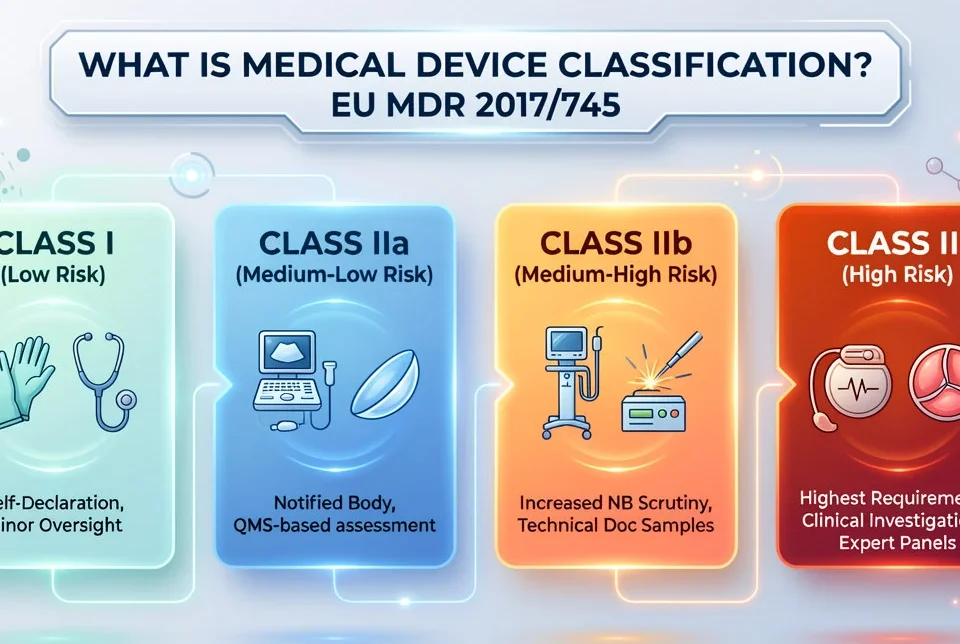
The Four Risk Classes Under MDR
Annex VIII defines four risk classes, consistent with the globally harmonized system:
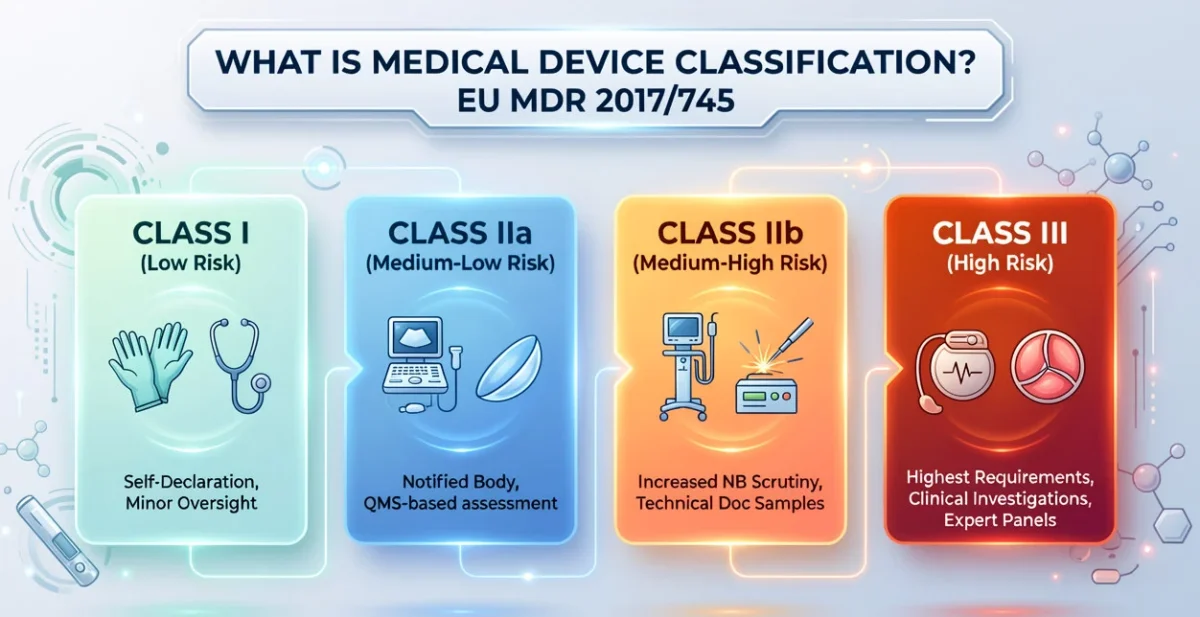
Class I: Low Risk
Devices with minimal invasiveness, short duration of contact, and low potential for harm. Examples include non-invasive bandages, examination gloves, stethoscopes, ophthalmoscopes, and tongue depressors.
Class I devices that are sterile, have a measuring function, or are reusable surgical instruments require Notified Body involvement for those specific aspects. The manufacturer can self-declare conformity for the general device but must have the sterile processing, metrological validation, or reprocessing validation reviewed by a Notified Body.
Many devices that were class I under the MDD have been up-classified under the MDR. Manufacturers who previously operated without Notified Body oversight may now need one for their devices.
Class IIa: Medium-Low Risk
Devices that are invasive for short-term use, active therapeutic devices intended for energy exchange in a non-hazardous way, or devices used for diagnosis if they administer medicinal products. Examples include contact lenses, ultrasound equipment, dental fillings, surgical clamps, and powered wheelchairs.
Conformity assessment for class IIa devices requires Notified Body involvement. The manufacturer can follow Annex IX (QMS-based assessment) or Annex X (type examination) combined with Annex XI (production QMS).
Class IIb: Medium-High Risk
Devices that are invasive for long-term use, active devices that administer or exchange energy in a potentially hazardous way, or devices intended for contraception or the prevention of sexually transmitted diseases. Examples include ventilators, bone fixation plates, surgical lasers, and certain implantable or long-term invasive devices. Some devices, such as insulin pens or wound dressings, may fall into Class IIa or Class IIb depending on their intended purpose, duration of use, and risk profile, and should therefore be classified on a case-by-case basis.
Class IIb devices are subject to increased Notified Body scrutiny. Under Annex IX Section 4.5, the Notified Body must assess a representative sample of technical documentation as part of conformity assessment. Certain Class IIb implantable devices may also be subject to the clinical evaluation consultation procedure under Article 54, depending on their risk and characteristics.
Class III: High Risk
Devices that come into contact with the central circulatory system or central nervous system, contain medicinal substances as an integral part, are absorbed by the body, or undergo chemical change in the body. Examples include pacemakers, heart valves, drug-eluting stents, absorbable sutures(in special circumstances), and implantable joint replacements.
Class III devices face the most stringent requirements. Notified Bodies must consult expert panels and, in some cases, the European Medicines Agency. Clinical investigations are normally mandatory under Article 61(4). The Clinical Evaluation Consultation Procedure under Article 54 applies to certain Class III and implantable devices.
The 22 Classification Rules (Annex VIII)
Annex VIII is divided into four sections, each covering a specific category of devices:”
Section I: Non-Invasive Devices (Rules 1-4)
Rule 1, Non-invasive devices that do not penetrate the body or channel bodily fluids: Class I.
Exceptions apply if the device is used for storing or channeling body fluids for eventual administration (Rule 1, second paragraph: Class IIa), or if it connects to an active medical device (Rule 1, third paragraph: Class IIa).
Rule 2, Non-invasive devices for channeling or storing body fluids for administration: Class IIa. If intended for circulation or power-driven ventilators: Class IIb.
Rule 3, Non-invasive devices that modify the biological or chemical composition of body fluids, tissues, or cells are classified as Class IIb. However, if the modification is achieved solely by filtration, centrifugation, or gas exchange, the device is classified as Class IIa.
Rule 4, Non-invasive devices that come into contact with injured skin or mucous membrane:
- Class I if intended to be used as a mechanical barrier, for compression or for absorption of exudates.
- Class IIb if intended to be used principally for injuries to skin which have breached the dermis and cannot heal by primary intention.
- Class IIa if principally intended to manage the micro-environment of injured skin or mucous membrane, and in all other cases.
Section II: Invasive Devices (Rules 5-8)
Rule 5, Invasive devices in relation to body orifices:
- Transient use (less than 60 minutes): Class I
- Short-term use (60 minutes to 30 days): Class IIa
- Long-term use (more than 30 days): Class IIb
- If connected to an active device class II or higher: Class IIb
Rule 6, Surgically invasive devices for transient use:
- Class IIa
- If reusable surgical instruments: Class I
- If intended for diagnosis, monitoring, or correction of a cardiac defect: Class III
- If intended for direct contact with the central circulatory system or central nervous system: Class III
Rule 7, Surgically invasive devices for short-term use:
- Class IIa
- If intended to administer medicinal products in a hazardous manner or undergo chemical change: Class IIb
- If intended for use in direct contact with the central nervous system: Class III
Rule 8, Implantable devices and long-term surgically invasive devices:
- Class IIb (General rule)
- If intended to be placed in the teeth: Class IIa
- If intended for use in direct contact with the heart, central circulatory system, or central nervous system: Class III
- If they are active implantable devices or their accessories: Class III
- If active or containing a medicinal substance: Class III
- If they are breast implants, surgical meshes, total/partial joint replacements, or spinal disc replacements: Class III
Section III: Active Devices (Rules 9-13)
Rule 9, Active therapeutic devices intended to administer or exchange energy:
- Class IIa
- If potentially hazardous energy (ionizing radiation, significant power): Class IIb
Rule 10, Active devices for diagnosis:
- Class IIa
- If for monitoring vital physiological parameters where variation could cause immediate danger: Class IIb
- If for emitting ionizing radiation: Class IIb
Rule 11, Software as a Medical Device (SaMD):
- Software intended to provide information which is used to take decisions with diagnosis or therapeutic purposes: Class IIa
- If such decisions have an impact that may cause death or an irreversible deterioration of a person’s state of health: Class III
- If such decisions have an impact that may cause a serious deterioration of a person’s state of health or a surgical intervention: Class IIb
- Software intended to monitor physiological processes: Class IIa (or Class IIb if monitoring vital physiological parameters where variations could result in immediate danger to the patient)
- All other software: Class I
This rule has been a major change under the MDR. Many software devices that were unclassified or class I under the MDD are now class IIa or higher. MDCG 2019-11 provides detailed guidance on software classification.
Rule 12, Active devices intended to administer medicinal products:
- Class IIa
- If in a hazardous manner or for life-saving medicines: Class IIb
Rule 13, All other active devices
- Class I
Section IV: Special Rules (Rules 14-22)
Rule 14, Devices incorporating medicinal substances as an integral part with ancillary action:
- Class III
Rule 15, Devices used for contraception or the prevention of the transmission of sexually transmitted diseases:
- Class IIb (or Class III if they are implantable or long-term invasive devices).
Rule 16, Devices for sterilization or disinfecting of medical devices:
- Class IIa (unless they are intended specifically for disinfecting invasive devices or as the end point of processing, in which case they are Class IIb).
Rule 17, Devices specifically intended for recording X-ray images:
- Class IIa
Rule 18, Devices manufactured utilizing non-viable human or animal tissues or cells, or their derivatives:
- Class III (unless the devices are intended to come into contact with intact skin only, in which case they are Class I).
Rule 19, Devices containing or consisting of nanomaterials:
- Class III if they present a high or medium potential for internal exposure.
- Class IIb if they present a low potential for internal exposure.
- Class IIa if they present a negligible potential for internal exposure.
Rule 20, Invasive devices with respect to body orifices intended to administer medicinal products by inhalation:
- Class IIa (or Class IIb if their mode of action has an essential impact on the efficacy and safety of the administered medicinal product or they are intended to treat life-threatening conditions).
Rule 21, Substances introduced into the body through a body orifice or applied to the skin and absorbed:
- Class III (if systemically absorbed in the gastrointestinal tract); Class IIb (if not systemically absorbed in the gastrointestinal tract); Class IIa (if applied to the skin, nasal, or oral cavity).
Rule 22, Active therapeutic devices with an integrated or incorporated diagnostic function which significantly determines patient management:
- Class III (Examples include closed-loop systems or automated external defibrillators).
Classification and Conformity Assessment
The classification directly controls the conformity assessment pathway:
| Class | Conformity Assessment Route | Notified Body Required |
| I | Annex II + III (self-declaration) | No (unless sterile/measuring/reusable) |
| IIa | Annex IX or Annex X + XI | Yes |
| IIb | Annex IX or Annex X + XI | Yes |
| III | Annex IX + clinical consultation or Annex X + XI | Yes |
For class I devices that are sterile, have a measuring function, or are reusable surgical instruments, the manufacturer must involve a Notified Body for those specific aspects even though the device itself is class I.
For class III devices, the manufacturer must also submit summaries of safety and clinical performance (SSCP) per Article 32. The Notified Body must validate the SSCP as part of the conformity assessment.
Common Classification Mistakes
Manufacturers frequently misclassify devices in the following areas:
Software classification: Rule 11 is complex and frequently misinterpreted. Software that simply stores or displays data is not a medical device. Software that interprets or analyzes data for medical purposes is a medical device and must be classified according to the severity of the clinical decision it supports.
Up-classification from MDD: Many devices that were class I under MDD have moved to class IIa or higher under MDR, requiring Notified Body involvement where none was needed before. Manufacturers of these devices must reassess their classification carefully.
Combination devices: Devices that incorporate a medicinal substance, human blood derivative, or are composed of nanomaterials require special attention as they likely fall into class III.
Multiple intended purposes: A device may have multiple intended purposes, each with a different classification. The highest classification applies.
Accessories: Accessories to medical devices are classified independently based on their own intended purpose, not the classification of the parent device (Article 2(2) MDR).
How to Determine Your Device Classification
The following steps represent the standard approach to classification:
- Define the intended purpose of the device in clear, written terms
- Identify the duration of contact with the body (transient, short-term, long-term, implantable)
- Determine if the device is invasive, surgically invasive, or active
- Apply the applicable rules from Annex VIII in order
- Check for special rules that may override general classifications
- Document the classification rationale in the technical file
- If uncertain, submit a request for classification to the competent authority
MDCG 2021-24 provides a structured approach to classification and includes decision trees for common device types. The document is available from the European Commission website.
Related Content
- EU MDR Compliance Complete Guide, Central hub for the series
- EU MDR 2017/745: Comprehensive Overview, Structure and scope of the regulation
- MDD to MDR: 10 Critical Changes, How the MDR differs from the MDD
- /services/mdr-medical-device-regulation-consulting/, MDRcert MDR consulting services
References
- Regulation (EU) 2017/745, Annex VIII, Classification rules. Available at: https://eur-lex.europa.eu/legal-content/EN/TXT/?uri=CELEX:32017R0745
- MDCG 2021-24, Guidance on classification of medical devices under Regulation (EU) 2017/745 and Regulation (EU) 2017/746. Available at: https://ec.europa.eu/docsroom/documents/42992
- MDCG 2019-11, Guidance on qualification and classification of software in Regulation (EU) 2017/745 and Regulation (EU) 2017/746. Available at: https://ec.europa.eu/docsroom/documents/34362
- European Commission NANDO database for Notified Body designation scope: https://ec.europa.eu/growth/tools-databases/nando/– European Commission – MDCG 2021-24 Classification Guidance: https://ec.europa.eu/health/medical-devices-sector/new-regulations/guidance-mdcg-endorsed-documents-and-other-guidance_en
- EUR-Lex – MDR Annex VIII Classification Rules: https://eur-lex.europa.eu/legal-content/EN/TXT/?uri=CELEX:02017R0745-20170505
Frequently Asked Questions (FAQ)
How does medical device classification work under the MDR?
Classification under Annex VIII assigns devices to one of four risk classes using 22 rules organized into four sections. The classification depends on the device’s intended purpose, duration of use, invasiveness, whether it is active, and the anatomical location of use as defined by the manufacturer.
How does Rule 11 classify software as a medical device?
Rule 11 classifies standalone software based on its intended purpose and clinical impact. Software providing information for treatment or diagnosis is class IIa, while software that can cause serious health deterioration or monitor vital physiological processes is class IIb or higher, as detailed in MDCG 2019-11 guidance.
How should a manufacturer determine the correct device classification?
The standard approach involves defining the intended purpose, identifying duration of contact, determining invasiveness, applying the applicable rules from Annex VIII in order, checking for special rules, and documenting the classification rationale. MDCG 2021-24 provides decision trees for common device types.
What is the difference between classification and risk class under the MDR?
The four risk classes are class I, class IIa, class IIb, and class III. Classification is the process of assigning a device to one of these classes, which then determines the conformity assessment route, clinical evidence requirements, and level of notified body oversight required.
How has reclassification changed from MDD to MDR?
Many devices that were class I under MDD have been up-classified under MDR, particularly software, nanomaterials, and devices incorporating substances absorbed by the body. This requires notified body involvement where none was needed before, increasing regulatory costs and certification timelines.