Introduction to Economic Operators
The EU MDR defines specific obligations for each economic operator in the medical device supply chain. MDR Economic Operators include manufacturers, authorized representatives, importers, and distributors. Each plays a distinct role in ensuring that devices placed on the European market are safe, perform as intended, and comply with all applicable regulatory requirements.
The MDR assigns clear legal responsibilities to each operator. Non-compliance by any operator can result in enforcement action by competent authorities, including restriction or prohibition of device availability on the market.
MDR Economic Operators Overview
For a full overview of the MDR framework, read the EU MDR Compliance Complete Guide.
Manufacturer (Article 10), Primary MDR Economic Operator
The manufacturer holds the broadest and most significant obligations under the MDR. Article 10 lists the full scope of manufacturer responsibilities.
Core Obligations
The manufacturer must:
- Design and manufacture in accordance with GSPRs: Devices must meet the General Safety and Performance Requirements set out in Annex I of the MDR. The manufacturer must document conformity through the technical documentation required under Annexes II and III.
- Conduct a clinical evaluation under Article 61 and Annex XIV. The clinical evaluation must produce a Clinical Evaluation Report (CER) that is updated with post-market surveillance data throughout the device lifecycle.
- Establish and maintain a QMS: The quality management system must cover all aspects of device design, manufacturing, final verification, and post-market activities. Most manufacturers align their QMS with ISO 13485:2016.
- Implement a risk management system in accordance with ISO 14971:2019 or equivalent. The risk management file must be maintained throughout the device lifecycle.
- Prepare technical documentation as described in Annexes II and III. The technical file must demonstrate conformity to each applicable GSPR.
- Draw up an EU declaration of conformity according to Article 19 and Annex IV. The declaration must be updated when the device or applicable standards change.
- Affix CE marking according to Article 20 and Annex V. CE marking indicates that the device meets all applicable MDR requirements.
- Register in EUDAMED as an actor and register devices with UDI information.
- Implement a PMS system according to Article 83 and produce PMS reports (class I) or PSURs (class IIa, IIb, III) at defined intervals.
- Establish a vigilance system for reporting serious incidents and field safety corrective actions.
- Designate a Person Responsible for Regulatory Compliance (PRRC) under Article 15.
- Maintain records and make them available to competent authorities upon request. This includes technical documentation, EU declaration of conformity, and certificates.
- Notify competent authorities of significant changes to devices or their intended purpose.
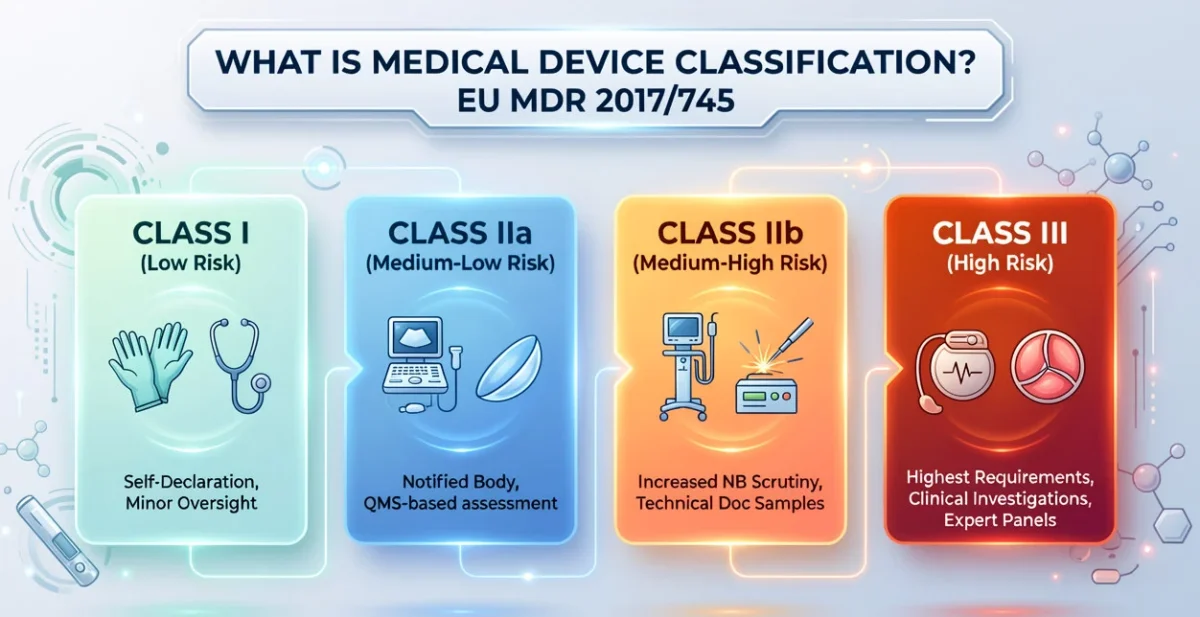
Special Provisions for Different Device Classes
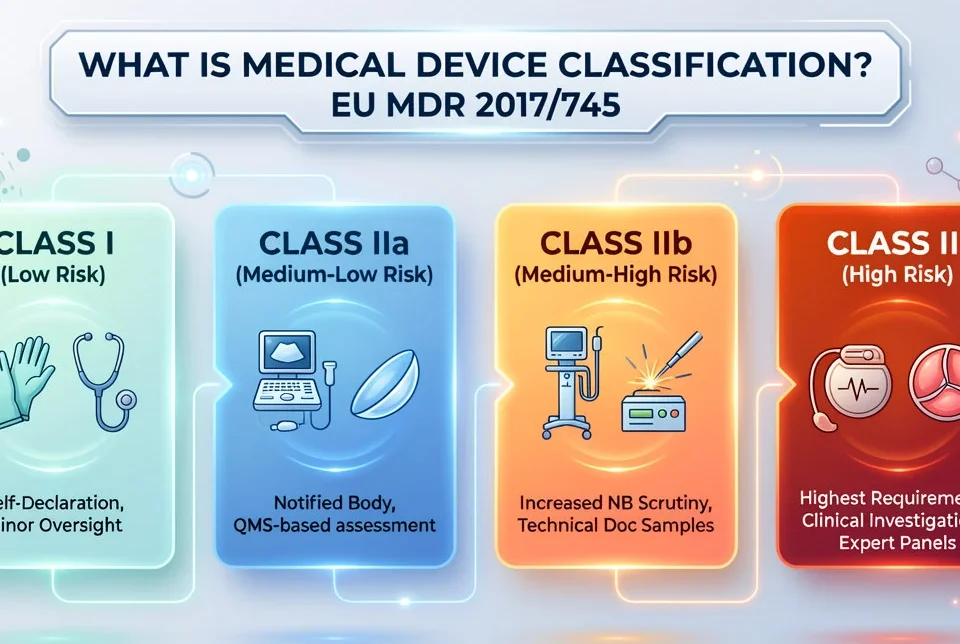
- Class I manufacturers: Can self-declare conformity without Notified Body involvement, except for sterile, measuring, or reusable surgical instrument aspects.
- Class IIa and IIb manufacturers: Must engage a Notified Body for conformity assessment and surveillance.
- Class III manufacturers: Face the most stringent requirements, including the Clinical Evaluation Consultation Procedure (Article 54) and potential expert panel review.
Manufacturer Responsibilities for Custom-Made Devices
Custom-made devices are subject to reduced requirements under Annex XIII. The manufacturer must document the design and manufacturing process and draw up a statement of manufacture rather than a full EU declaration of conformity.However, Class III custom-made implantable devices are additionally subject to Notified Body assessment of the QMS (Article 52(8)).
Authorized Representative (Article 11), Key MDR Economic Operator
Any manufacturer established outside the EU (with the exception of countries having specific Customs Union agreements, such as Turkey, which do not require an AR for MDR compliance) must appoint a single authorized representative established in the Union. The authorized representative acts on behalf of the manufacturer before EU competent authorities.
Mandate and Responsibilities
The authorized representative must have a written mandate from the manufacturer. The mandate must specify the tasks that the authorized representative is authorized to perform. The minimum obligations of the authorized representative under Article 11(3) include:
- Verify that the EU declaration of conformity and technical documentation have been drawn up and, where applicable, that an appropriate conformity assessment has been carried out.
- Keep the technical documentation, the EU declaration of conformity, and the relevant certificates available for competent authorities for at least 10 years after the last device has been placed on the market (or at least 15 years for implantable devices).
- Register in EUDAMED as an actor and confirm the manufacturer registration.
- Provide competent authorities with requested information within a reasonable timeframe.
- Forward to the manufacturer any requests from competent authorities and ensure the manufacturer responds appropriately.
- Cooperate with competent authorities on any preventive or corrective actions.
- Terminate the mandate if the manufacturer violates its obligations. The authorized representative must inform the competent authority of the termination.
Liability
Under Article 11(5), the authorized representative is jointly and severally liable with the manufacturer for defective devices, without prejudice to Directive 85/374/EEC on product liability.
Importer (Article 13)
Importers bring devices from third countries into the EU market. The MDR imposes specific obligations on importers to ensure that devices entering the EU meet regulatory requirements.
Core Obligations
- Before placing a device on the market, the importer must verify that:
- The device bears CE marking
- The EU declaration of conformity has been drawn up
- The manufacturer is identified and has an authorized representative in the EU
- The device is labeled correctly and accompanied by instructions for use in the appropriate language
- The UDI has been assigned by the manufacturer
- Store and transport devices under appropriate conditions to maintain their conformity.
- Register in EUDAMED as an actor.
- Maintain a register of devices placed on the market, including information on complaints and non-conforming devices.
- Cooperate with competent authorities on any preventive or corrective actions.
- Inform the manufacturer and competent authorities if they suspect a device is not compliant or presents a serious risk.
- Return or destroy non-conforming devices if corrective action is required.
Distributor (Article 14)
Distributors make devices available on the market without being the manufacturer or importer. Distributors include wholesalers, retailers, and online platforms.
Core Obligations
- Before making a device available, the distributor must verify that:
- The device bears CE marking
- The EU declaration of conformity is available
- The manufacturer and importer (if applicable) are identified
- The device labeling and instructions are in the appropriate language
- The UDI has been assigned
- Store and transport devices under appropriate conditions.
- Cooperate with competent authorities on preventive and corrective actions.
- Inform the manufacturer, importer, and competent authorities if they suspect non-compliance or serious risk.
- Keep records of device traceability as required by applicable national law.
Distributors that modify a device in a way that affects its conformity with the MDR are considered manufacturers and must assume the full responsibilities of a manufacturer.
Person Responsible for Regulatory Compliance (Article 15)
The MDR introduces a new requirement under Article 15 for every manufacturer to have at least one Person Responsible for Regulatory Compliance (PRRC) within their organization. The PRRC must be permanently and continuously available.
Qualification Requirements
The PRRC must have one of the following qualifications:
- A university degree in law, medicine, pharmacy, engineering, or another relevant scientific discipline, plus at least one year of professional experience in regulatory affairs or quality management relating to medical devices
- Four years of professional experience in regulatory affairs or quality management relating to medical devices (for manufacturers without the required degree)
Micro and small enterprises do not have to employ the PRRC internally but must have the person permanently and continuously at their disposal.
Responsibilities
The PRRC is responsible for at least the following:
- Ensuring the conformity of devices is assessed before release
- Ensuring the technical documentation and EU declaration of conformity are maintained
- Ensuring post-market surveillance obligations are fulfilled
- Ensuring reporting obligations under Articles 87-91 are met
- Ensuring that, for investigational devices, the statement referred to in Section 4.1 of Chapter II of Annex XV is issued
The PRRC must not be disadvantaged within the organization for fulfilling these responsibilities.
Obligations by Device Class
| Obligation | Class I | Class IIa | Class IIb | Class III |
| — | — | — | — | — |
| Technical documentation (Annex II+III) | Yes | Yes | Yes | Yes |
| QMS (Annex IX) | Yes | Yes | Yes | Yes |
| Notified Body audit | No* | Yes | Yes | Yes |
| Clinical Evaluation (CER) | Yes | Yes | Yes | Yes |
| Clinical Investigation (Art. 61) | No** | No** | No** | Mandatory*** |
| PMCF (Annex XIV Part B) | Yes | Yes | Yes | Yes |
| PMS Report | Yes | No | No | No |
| PSUR | No | 2 years | 1 year | 1 year |
| SSCP | No† | No† | No† | Required |
| UDI | Yes | Yes | Yes | Yes |
| EUDAMED registration | Yes | Yes | Yes | Yes |
| PRRC (Art. 15) | Yes | Yes | Yes | Yes |
*Class I sterile/measuring/reusable surgical instruments require Notified Body for those aspects.
**Clinical investigation may be required for class I or II devices if clinical data from literature or equivalence is insufficient.
***Class III and implantable devices require a clinical investigation under Article 61(4), unless sufficient existing clinical data from the device in question or an equivalent device is available.
†SSCP is required for class III and implantable devices (any class) under Article 32; non-implantable class I/IIa/IIb devices do not require an SSCP.
Traceability and UDI
All economic operators must participate in the Unique Device Identification (UDI) system established under Articles 27-28 and Part C of Annex VI. The UDI system consists of:
- UDI-DI: The device identifier specific to a device model or type
- UDI-PI: The production identifier that identifies the device unit of production
- Basic UDI-DI: The key identifying the device group for EUDAMED registration
Economic operators must be able to identify which devices were supplied to which operators and, for implantable devices, which patients received which devices. This traceability extends throughout the supply chain.
Related Content
- EU MDR Compliance Complete Guide, Central hub for the series
- EU MDR 2017/745: Comprehensive Overview, Structure and scope of the regulation
- Medical Device Classification Under EU MDR, Annex VIII classification rules
- General Safety and Performance Requirements, GSPR compliance guide
- Notified Body Selection and Audit Preparation, NB selection guide
- /services/mdr-medical-device-regulation-consulting/, MDRcert MDR consulting services
- /contact-us/, Contact MDRcert
References
- Regulation (EU) 2017/745, Article 10, Manufacturer obligations. Available at: https://eur-lex.europa.eu/legal-content/EN/TXT/?uri=CELEX:32017R0745
- Regulation (EU) 2017/745, Article 11, Authorized representative. Available at: https://eur-lex.europa.eu/legal-content/EN/TXT/?uri=CELEX:32017R0745
- Regulation (EU) 2017/745, Article 13, Importer obligations. Available at: https://eur-lex.europa.eu/legal-content/EN/TXT/?uri=CELEX:32017R0745
- Regulation (EU) 2017/745, Article 14, Distributor obligations. Available at: https://eur-lex.europa.eu/legal-content/EN/TXT/?uri=CELEX:32017R0745
- Regulation (EU) 2017/745, Article 15, Person responsible for regulatory compliance. Available at: https://eur-lex.europa.eu/legal-content/EN/TXT/?uri=CELEX:32017R0745
- Regulation (EU) 2017/745, Articles 27-28, UDI system and EUDAMED. Available at: https://eur-lex.europa.eu/legal-content/EN/TXT/?uri=CELEX:32017R0745
- MDCG 2019-6, Guidance on the application process for conformity assessment under MDR. Available at: https://ec.europa.eu/docsroom/documents/35123– European Commission – Medical Device Regulations: https://ec.europa.eu/health/medical-devices-sector_en
- EUR-Lex – MDR Articles 10-16 Economic Operators: https://eur-lex.europa.eu/legal-content/EN/TXT/?uri=CELEX:02017R0745-20170505
Frequently Asked Questions (FAQ)
What are the main obligations of a manufacturer under EU MDR?
The manufacturer holds the broadest obligations under Article 10 of the MDR, including designing devices in accordance with GSPRs, conducting clinical evaluations, establishing a QMS, implementing risk management per ISO 14971, preparing technical documentation, affixing CE marking, and designating a PRRC under Article 15.
What is the role of an authorised representative under EU MDR?
Any manufacturer established outside the EU (with the exception of countries having specific Customs Union agreements, such as Turkey) must appoint a single authorised representative established in the Union under Article 11. The authorised representative acts on behalf of the manufacturer before EU competent authorities and can be held jointly and severally liable for defective devices.
What is the difference between an importer and a distributor under the MDR?
Importers bring devices from third countries into the EU market and must verify CE marking, the EU declaration of conformity, and correct labeling before placing a device on the market. Distributors make devices available on the market without being the manufacturer or importer and must verify that CE marking and labeling requirements are met.
Can an authorised representative be held liable for non-compliant devices?
Yes, the authorised representative can be held jointly and severally liable for defective devices if the manufacturer is not established in the EU and has not complied with its obligations. The authorised representative must also terminate the mandate if the manufacturer violates its obligations and inform the competent authority.
What qualifications must a Person Responsible for Regulatory Compliance have?
Under Article 15, the PRRC must have a university degree in law, medicine, pharmacy, engineering, or a relevant scientific discipline plus at least one year of professional experience in regulatory affairs relating to medical devices. Alternatively, four years of professional experience in regulatory affairs or quality management relating to medical devices is acceptable.