Introduction to EU MDR 2017/745 Overview
This EU MDR 2017/745 Overview covers the structure, scope, and key requirements of Regulation (EU) 2017/745, the most significant overhaul of medical device legislation in European history. Adopted by the European Parliament and the Council of the European Union on 5 April 2017, it entered into force on 25 May 2017 and became fully applicable on 26 May 2021.
EU MDR 2017/745 Overview: The regulation replaces the earlier Medical Device Directive (MDD 93/42/EEC) and the Active Implantable Medical Device Directive (AIMDD 90/385/EEC). The full text of EU MDR 2017/745 is available on EUR-Lex. It raises the bar for patient safety, clinical evidence, transparency, and post-market surveillance across the entire medical device lifecycle. Any manufacturer that places a medical device on the European market must comply with this regulation.
Legislative Background
Why Was the MDR Introduced?
The transition from directives to a regulation was driven by several high-profile public health failures that exposed gaps in the existing regulatory framework.
The PIP breast implant scandal (2010) was the tipping point. French company Poly Implant Prothèse used unauthorised industrial-grade silicone instead of medical-grade silicone in its breast implants. The fraud affected hundreds of thousands of women across Europe and revealed that the existing conformity assessment system under the MDD did not provide adequate oversight of notified bodies or manufacturers.
The metal-on-metal hip implant failures further exposed weaknesses. Devices such as the DePuy ASR hip system showed high failure rates years after market placement. The MDD framework lacked robust post-market surveillance requirements to detect and act on emerging safety signals in real time.
A 2014 European Commission study on the functioning of the MDD identified systemic problems: insufficient clinical evidence requirements, weak oversight of notified bodies, lack of device traceability, and no central database for device safety information. The MDR was drafted to address each of these deficiencies.
From Directives to Regulations
Under EU law, a directive sets out goals that member states must achieve through their own national legislation. The MDD was transposed into 28 different national laws, creating inconsistencies in interpretation and enforcement across member states.
A regulation is directly applicable in all member states. It does not require national transposition. MDR 2017/745 applies uniformly across all EU member states and the European Economic Area (EEA). This eliminates the patchwork of national interpretations that existed under the MDD and creates a single, harmonised regulatory framework.
The MDR is also structured differently from the MDD. It contains ten chapters and seventeen annexes, compared to the MDD’s 23 articles and 12 annexes. The MDR is more detailed, prescriptive, and enforceable.
Official source: EUR-Lex: Regulation (EU) 2017/745
Key Objectives of the MDR
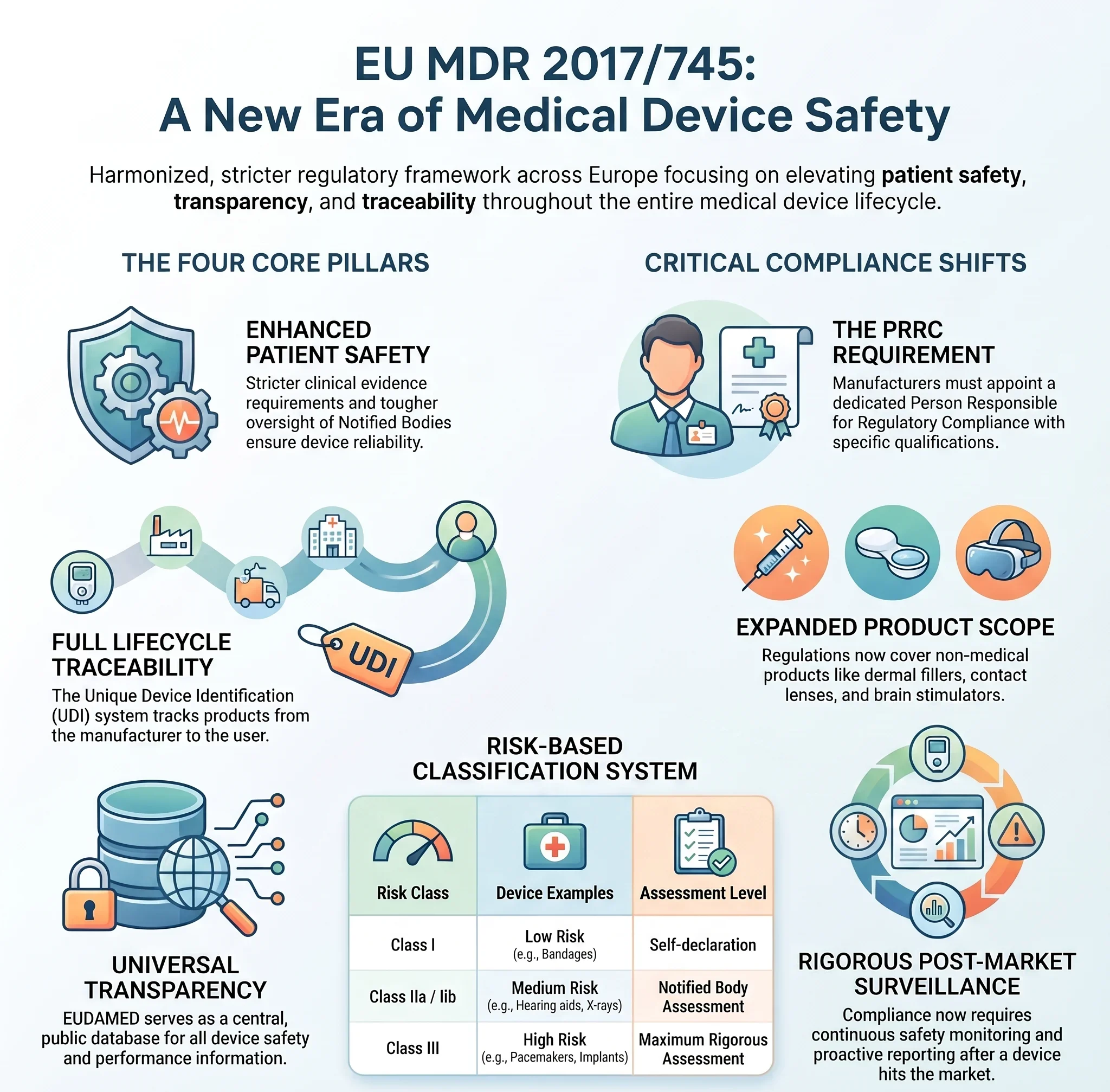
The MDR establishes four core objectives that drive every provision in the regulation:
- Patient safety: Strengthen clinical evidence requirements, enhance post-market surveillance, and impose stricter criteria for notified body oversight.
- Transparency: Establish EUDAMED as a central database for device information, create a Unique Device Identification (UDI) system, and require public access to safety and clinical performance data.
- Traceability: Enable full lifecycle traceability of devices from manufacturer through distributor to end user via the UDI system and implant cards.
- Innovation: Maintain a balanced regulatory environment that encourages medical device innovation while ensuring safety. Provisions for clinical investigations and device certifications include pathways for novel technologies.
Scope of the Regulation
Article 1: Subject Matter and Scope
Article 1 defines the scope of the regulation. The MDR applies to:
- Medical devices and their accessories
- Certain cosmetic and non-medical products listed in Annex XVI (including contact lenses, liposuction equipment, dermal fillers, and tattooing equipment)
- Devices manufactured in-house by healthcare institutions under specific conditions (Article 5(5))
The regulation does not apply to in vitro diagnostic medical devices (covered separately by IVDR 2017/746), medicinal products, human blood or blood products, or transplants.
Article 2: Definitions
Article 2 contains 71 definitions that govern the interpretation of the entire regulation. Key definitions include:
- Medical device: Any instrument, apparatus, appliance, software, implant, reagent, material, or other article intended for human beings for diagnosis, prevention, monitoring, prediction, prognosis, treatment, or alleviation of disease
- Manufacturer: A natural or legal person who manufactures or fully refurbishes a device
- Authorised representative: Any natural or legal person established in the Union who has received a written mandate from a manufacturer to act on their behalf
- Clinical evaluation: A systematic and planned process to continuously generate, collect, analyse, and assess clinical data
Devices Covered
The MDR defines a medical device based on intended purpose, which is determined by the manufacturer. This is a critical concept because the same physical product can be a medical device or a non-medical product depending on the claims made by the manufacturer.
Annex XVI extends the scope to include six categories of products without an intended medical purpose but that are functionally similar to medical devices:
- Contact lenses or other items intended to be introduced into or onto the eye
- Products intended to be introduced into the human body through surgically invasive means (e.g., dermal fillers)
- Substances intended to be used for facial or other dermal/mucous membrane filling by injection
- Equipment for liposuction, lipolysis, or cellulite reduction
- High-intensity electromagnetic radiation equipment for skin treatment
- Equipment for brain stimulation
These products must now meet MDR requirements even though they do not treat or diagnose disease.
Structure of the MDR
MDR 2017/745 is organised into ten chapters and seventeen annexes:
| Chapter | Title | Key Content |
| ——— | ——- | ————- |
| I | Scope and Definitions | Articles 1-4, subject matter, scope, definitions |
| II | Making Available of Devices and Obligations | Articles 5-24, CE marking, economic operator obligations |
| III | Identification and Traceability | Articles 25-34, UDI system, EUDAMED, device registration |
| IV | Notified Bodies | Articles 35-50, designation, oversight, joint assessments |
| V | Classification and Conformity Assessment | Articles 51-60, classification rules, conformity assessment procedures |
| VI | Clinical Evaluation and Investigations | Articles 61-82, clinical evidence requirements, PMCF, clinical investigations |
| VII | Post-Market Surveillance | Articles 83-92, PMS system, PSUR, trend reporting, vigilance, FSCA |
| VIII | Cooperation Between Member States | Articles 93-100, MDCG, Expert Panels, market surveillance |
| IX | Confidentiality and Data Protection | Articles 101-110, trade secrets, GDPR compliance |
| X | Final Provisions | Articles 111-123, delegated acts, transitional provisions, repeal of MDD/AIMDD |
The seventeen annexes contain detailed technical requirements:
- Annex I: General Safety and Performance Requirements (GSPR), the most referenced annex in the regulation
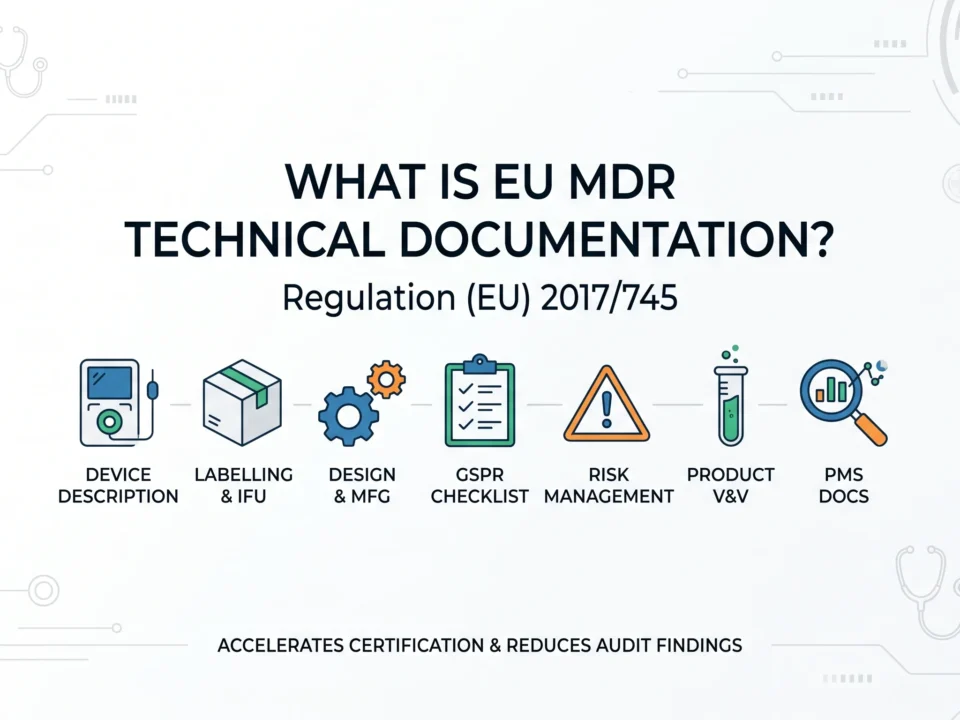
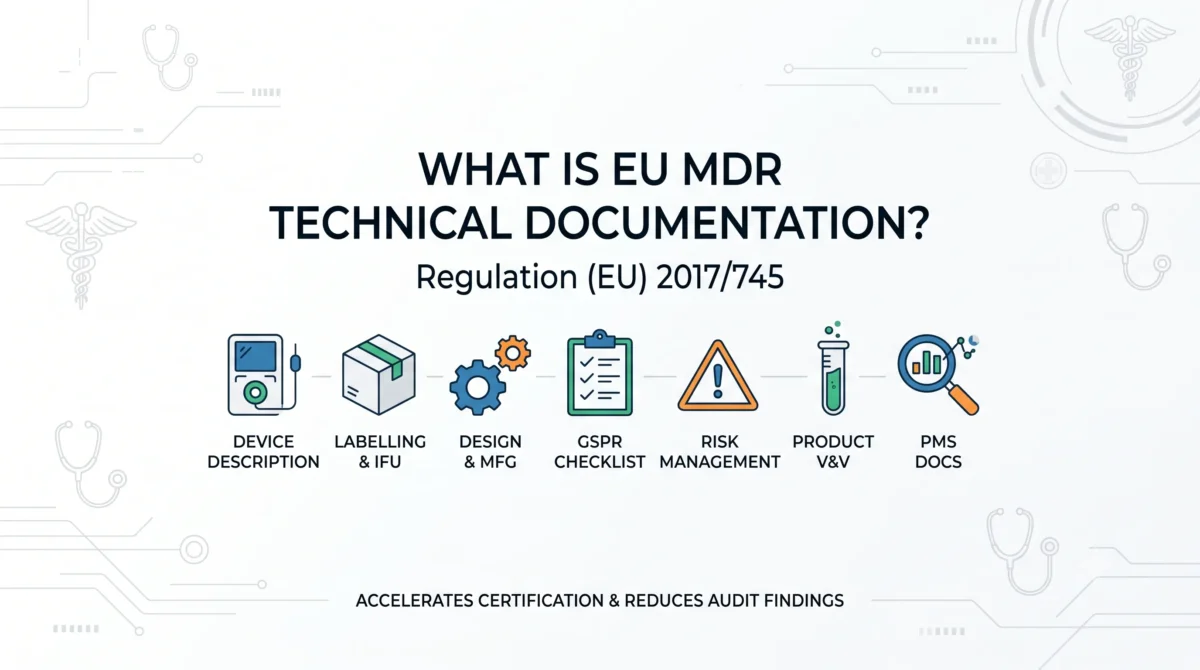
- Annex II: Technical Documentation
- Annex III: Post-Market Surveillance Technical Documentation
- Annex IV: EU Declaration of Conformity
- Annex V: CE Marking
- Annex VI: UDI system and registration requirements
- Annex VII: Notified Body Requirements
- Annex VIII: Classification Rules
- Annex IX: Conformity Assessment Based on Quality Management System (Annex IX)
- Annex X: Conformity Assessment Based on Type Examination
- Annex XI: Conformity Assessment Based on Product Conformity Verification
- Annex XII: Certificates
- Annex XIII: Custom-made Devices
- Annex XIV: Clinical Evaluation and Post-Market Clinical Follow-up
- Annex XV: Clinical Investigations
- Annex XVI: Products Without an Intended Medical Purpose
- Annex XVII: Correlation Table
Risk Classification System
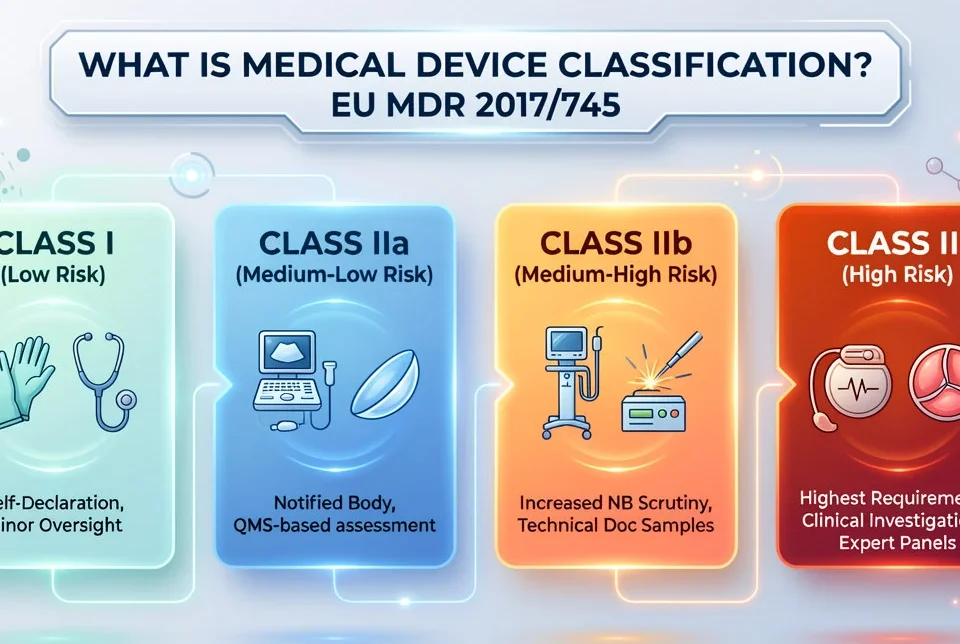
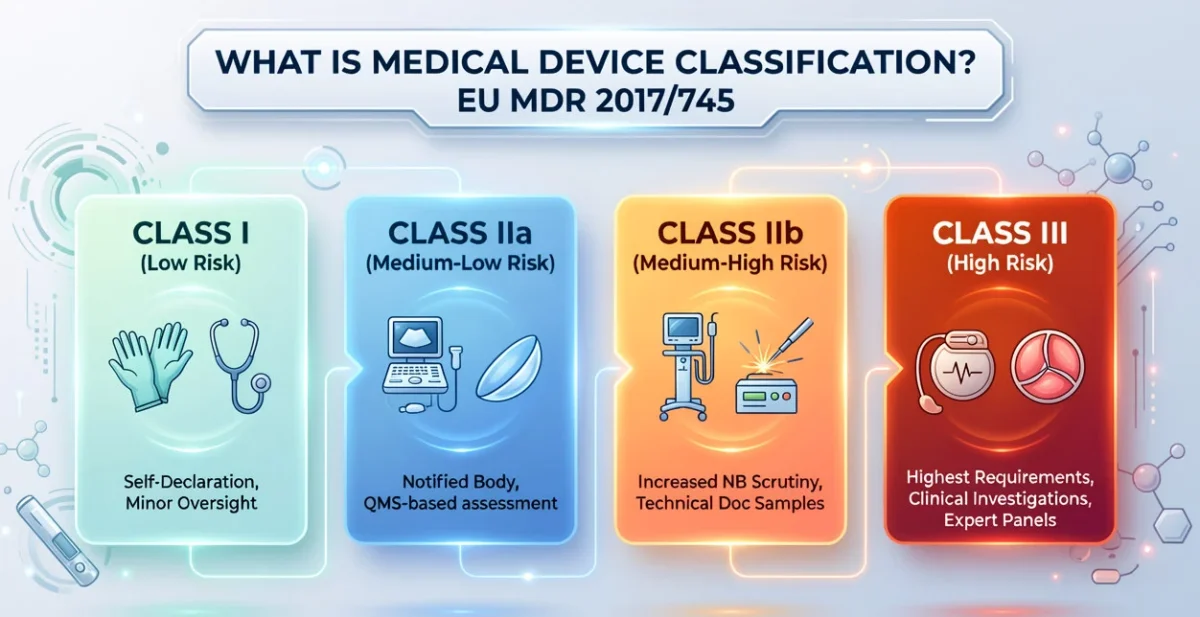
Medical devices under the MDR are classified into four risk classes based on Annex VIII: Class I (low risk), Class IIa (medium risk), Class IIb (medium-high risk), and Class III (high risk).
The classification rules are organised into 22 rules covering:
- Rules 1-4: Non-invasive devices
- Rules 5-8: Invasive devices (including surgically invasive devices)
- Rules 9-13: Active devices (therapeutic, diagnostic, software, and devices administering medicinal products)
- Rules 14-17: Special rules (devices incorporating medicinal substances, human blood derivatives, sterilization, and X-ray recording)
- Rule 18: Devices manufactured from non-viable human/ animal tissues or cells
- Rule 19: Devices containing nanomaterials
- Rule 20: Invasive devices intended to administer medicinal products by inhalation
- Rules 21-22: Devices composed of substances absorbed by the body (Rule 21) and devices used for contraception or prevention of sexually transmitted diseases(Rule 22)
The MDR introduced significant changes to classification. Most notably, Rule 11 now classifies standalone software as a medical device (SaMD) based on its intended purpose and clinical impact. Many software products that were Class I under the MDD have been up-classified to Class IIa or higher under the MDR.
The classification determines the conformity assessment route. Class I devices generally allow self-declaration. Class IIa, IIb, and III devices require notified body involvement, with Class III devices subject to the most rigorous assessment.
Key Players and Responsibilities
Manufacturer (Article 10)
Article 10 defines the obligations of manufacturers. They bear the primary responsibility for device compliance and must:
- Design and manufacture devices in accordance with Annex I GSPR
- Establish, document, implement, and maintain a quality management system (QMS)
- Conduct clinical evaluation per Article 61 and Annex XIV
- Draft technical documentation per Annexes II and III
- Implement and maintain a risk management system
- Affix CE marking and draw up the EU Declaration of Conformity
- Register in EUDAMED
- Implement post-market surveillance per Article 83
- Report serious incidents and field safety corrective actions (FSCA)
Authorised Representative (Article 11)
Article 11 applies to manufacturers established outside the EU. An authorised representative (AR) based in the EU must be appointed by written mandate. The AR shares certain legal liabilities but the manufacturer retains primary responsibility. The AR must:
- Verify the EU Declaration of Conformity and technical documentation
- Maintain a copy of technical documentation and the EU Declaration of Conformity
- Cooperate with competent authorities on corrective actions
- Fulfil registration obligations on behalf of the manufacturer
The AR now carries direct liability under the MDR, a significant change from the MDD.
Importer (Article 13)
Article 13 defines importer obligations. Importers are responsible for devices brought into the EU from third countries. They must:
- Verify CE marking and the EU Declaration of Conformity
- Ensure the manufacturer and AR are identified on the device labelling
- Verify that the device has been registered in EUDAMED
- Maintain a register of complaints, non-conforming devices, and recalls
- Cooperate with competent authorities
Distributor (Article 14)
Article 14 governs distributors. Distributors must act with due care and verify that devices bear CE marking, the EU Declaration of Conformity is available, and labelling requirements are met. Distributors must also:
- Store and transport devices under appropriate conditions
- Maintain a register of complaints and non-conforming devices
- Cooperate with corrective actions and recalls
Person Responsible for Regulatory Compliance (Article 15)
Article 15 introduces a new role not present in the MDD. Every manufacturer must have at least one qualified person responsible for regulatory compliance (PRRC). This person must possess:
- A diploma in law, medicine, pharmacy, engineering, or another relevant scientific discipline, plus at least one year of professional experience in regulatory affairs or quality management
- Or four years of professional experience in regulatory affairs or quality management
The PRRC is responsible for ensuring the conformity assessment procedures are followed, technical documentation and the EU Declaration of Conformity are maintained, and post-market surveillance obligations are fulfilled.
For micro and small enterprises, the PRRC may be external, but must be permanently and continuously available.
Notified Bodies
Notified bodies are independent organisations designated by EU member states to assess device conformity. Under the MDR, notified bodies face far stricter requirements than under the MDD.
Key changes include:
- Joint assessments: Notified bodies are assessed jointly by the competent authority and an EU assessment team, with unannounced onsite audits.
- Specialist staff: Notified bodies must employ sufficient qualified personnel with clinical expertise, not just technical expertise.
- Designation scope: Notified bodies must apply for specific designation codes that define the types of devices they can assess.
- Subcontracting limits: Critical tasks cannot be subcontracted.
As of 2025, over 40 notified bodies are designated under the MDR, compared to over 80 under the MDD. This has created significant bottlenecks in the certification pipeline.
European Commission list: Notified Bodies under MDR
Essential Changes Introduced by the MDR
Enhanced Clinical Evidence Requirements
The MDR transforms clinical evaluation from a documentation exercise into a continuous, evidence-driven process. Article 61 requires manufacturers to demonstrate that devices achieve their intended clinical performance and are safe based on sufficient clinical evidence.
Key changes:
- Clinical investigations are generally expected for Class III and implantable devices, unless sufficiently justified otherwise.
- Post-market clinical follow-up (PMCF) is mandatory under Annex XIV Part B.
- Equivalent device claims are more restrictive; manufacturers can no longer rely on equivalence to avoid conducting clinical investigations unless the device is demonstrably equivalent in design, materials, manufacturing, and clinical application.
- In practice, equivalence is difficult unless sufficient access to technical data is available (often within the same manufacturer group)
UDI System
The MDR introduces a Unique Device Identification (UDI) system under Article 27 and Annex VI to improve traceability throughout the supply chain and enhance recall effectiveness.
Each device must carry a UDI composed of:
- UDI-DI (Device Identifier): Identifies the device model and manufacturer
- UDI-PI (Production Identifier): Identifies the lot, serial number, expiration date, or manufacturing date
The UDI must be placed on the device label and all higher-level packaging. UDI data must be submitted to EUDAMED.
EUDAMED Database
Article 33 establishes the European Database on Medical Devices (EUDAMED) as the central repository for device information. EUDAMED is structured into six modules:
- Actor registration
- UDI and device registration
- Notified bodies and certificates
- Clinical investigations and performance studies
- Vigilance and post-market surveillance
- Market surveillance
When fully functional / once fully deployed EUDAMED will provide public access to device information and increase transparency across the market.
EUDAMED public portal: https://ec.europa.eu/tools/eudamed
Implant Card and Patient Information
Article 18 introduces the implant card, a new requirement for implantable devices. The implant card must be provided to the patient and contain:
- Device name, serial number, lot number, UDI
- Manufacturer name and contact details
- Warnings, precautions, and expected lifetime
- Information about potential risks and contraindications
The implant card enables patients to track their implanted devices and receive timely safety information.
Stricter Requirements for Notified Bodies (Joint Assessments)
Notified body designation under the MDR requires compliance with Article 38 and Annex VII. Designated notified bodies must undergo:
- Joint assessment by the competent authority and an EU team
- Unannounced onsite audits every 12 months
- Reassessment every four years
This has significantly reduced the number of designated notified bodies and increased the cost and duration of conformity assessments.
Relationship With Other Regulations
IVDR 2017/746
The In Vitro Diagnostic Regulation (IVDR) 2017/746 is the companion regulation to the MDR. While the MDR covers medical devices, IVDR covers in vitro diagnostic medical devices. Both regulations share similar structures, definitions, and requirements for clinical evidence, UDI, EUDAMED, and post-market surveillance. Manufacturers of both device types should approach compliance as an integrated programme.
GDPR
The General Data Protection Regulation (EU) 2016/679 intersects with the MDR in several areas. Device software processing personal data must comply with GDPR requirements for data protection by design, data subject rights, data breach notification, and privacy impact assessments. Clinical investigations involve processing personal data and must comply with both regulations simultaneously.
ISO Standards as Harmonised Standards
The European Commission publishes harmonised standards in the Official Journal of the European Union (OJEU). Compliance with these standards provides a presumption of conformity with relevant MDR requirements.
Key harmonised standards include:
- ISO 13485:2016, Quality management systems for medical devices
- ISO 14971:2019, Risk management for medical devices (EN ISO 14971:2019 + A11:2021 is the harmonised standard under MDR)
- ISO 14155:2020, Clinical investigation of medical devices
- IEC 62366-1:2015, Usability engineering
- IEC 62304:2006, Medical device software life cycle processes
Manufacturers should monitor the OJEU for updates to the list of harmonised standards, as standards not cited in the OJEU do not provide presumption of conformity.
Official source: EU Harmonised Standards
Timeline and Transitional Provisions
The MDR was originally scheduled to apply from 26 May 2020. The European Commission postponed this by one year due to the COVID-19 pandemic, moving the Date of Application (DoA) to 26 May 2021.
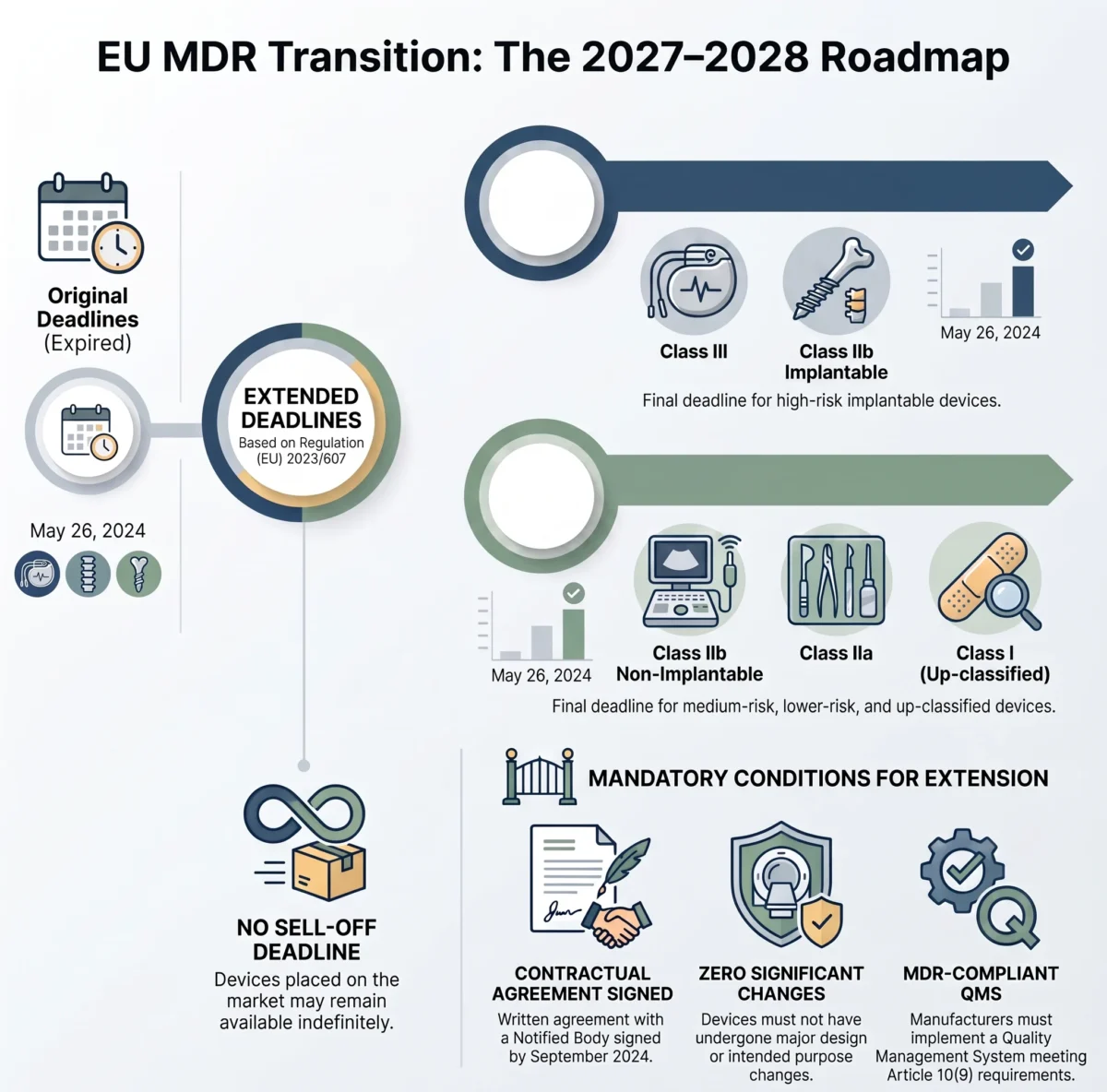
The transitional provisions are governed by Article 120 and allow devices with valid MDD or AIMDD certificates to remain on the market under specific conditions:
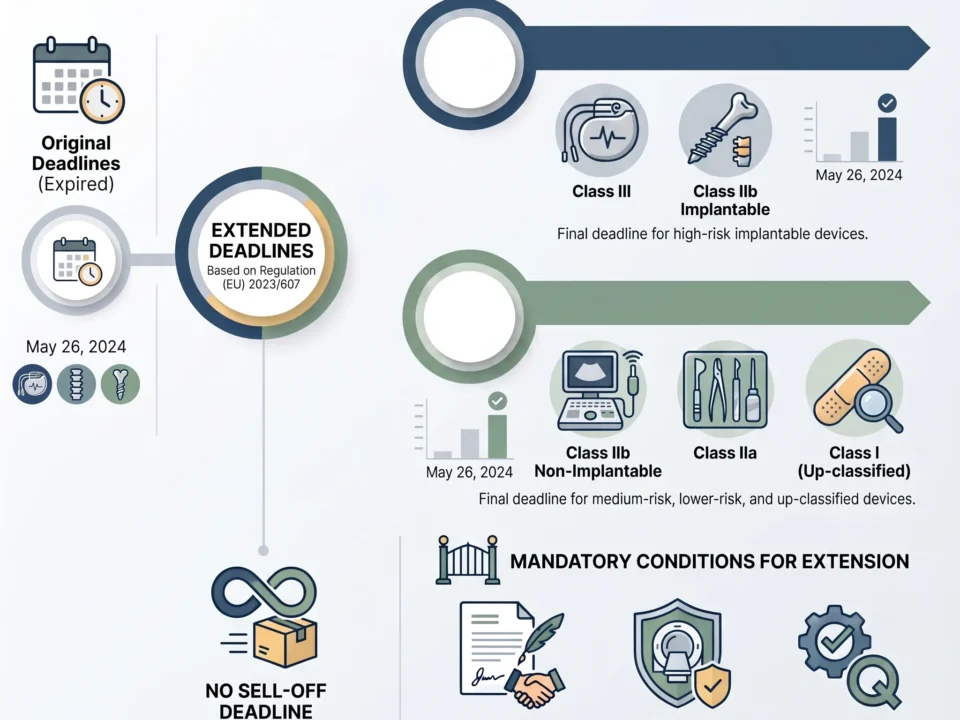
- Devices with valid MDD certificates issued before 26 May 2021 could continue to be placed on the market until the certificate expired, or until 26 May 2024 (whichever was earlier). Regulation (EU) 2023/607 subsequently extended certain transitional periods.
- Devices with valid certificates under the MDR that were placed on the market before the DoA can continue to be made available.
- “Sell-off” provisions allow devices that were placed on the market before the end of the transitional period to continue being made available to end users without time limit.
- Devices must not undergo significant changes and must have an MDR-compliant QMS in place.
Amendment Regulation (EU) 2023/607 extended certain transitional timelines. Key changes from this amendment include:
- Class III and Class IIb implantable devices: transitional period extended to 31 December 2027 (if a formal application has been submitted to the notified body by 26 May 2024)
- Class IIb non-implantable, Class IIa, Class Is, and Class Im devices: transitional period extended to 31 December 2028
- The “sell-off” date was set as the end of the device’s lifetime or the date the device is no longer made available
Manufacturers must act now. Waiting until the extended deadlines are near will risk market access.
Official source: MDR Transitional Provisions – European Commission
Practical Implications for Manufacturers
- Certification timelines have increased from 12-18 months under the MDD to 18-36 months under the MDR. Plan accordingly.
- Clinical evaluation under Article 61 requires more data, more documentation, and more rigorous scientific justification than under the MDD. Start early.
- Post-market surveillance is no longer an afterthought. A PMS system, PMS report (for Class I), PSUR (for Class IIa and above), and PMCF plan are mandatory.
- Person responsible for regulatory compliance (Article 15) must be designated and documented. Ensure the PRRC has the required qualifications and is continuously available.
- UDI implementation requires investment in labelling systems, data management, and EUDAMED registration.
How MDRcert Can Help
Navigating MDR 2017/745 requires deep regulatory expertise, structured processes, and a practical understanding of notified body expectations. MDRcert provides end-to-end regulatory consulting for medical device manufacturers.
Our services cover:
- Gap analysis between MDD compliance and MDR requirements (services)
- Technical documentation compilation aligned with Annex II and Annex III
- Clinical evaluation strategy, including CER writing and PMCF planning
- QMS implementation and ISO 13485 integration (MDR consulting)
- Notified body submission management and audit support
- PRRC outsourcing and regulatory staffing
- EUDAMED registration and UDI management
Contact our regulatory team to discuss your MDR compliance project. (contact us)
References
- Regulation (EU) 2017/745 of the European Parliament and of the Council of 5 April 2017 on medical devices. Available at: EUR-Lex
- Medical Device Coordination Group (MDCG) guidance documents: European Commission MDCG Guidance
- Regulation (EU) 2023/607 transitional provisions: EUR-Lex
Related Content
- EU MDR Compliance Complete Guide, Central hub for the series
- MDD to MDR: 10 Critical Changes, Detailed comparison of the two regulatory frameworks
Frequently Asked Questions (FAQ)
When did the EU MDR 2017/745 become applicable?
The MDR was adopted on April 5, 2017, entered into force on May 25, 2017, and became fully applicable on May 26, 2021. The original 2020 date of application was postponed by one year due to the COVID-19 pandemic.
What is the scope of the EU MDR 2017/745?
The MDR applies to medical devices and their accessories, including active implantable devices, and certain cosmetic products listed in Annex XVI. It does not apply to in vitro diagnostic devices covered by IVDR 2017/746, medicinal products, or human blood, blood products, plasma, or blood cells of human origin.
What is the difference between a directive and a regulation under EU law?
A directive sets out goals that member states must achieve through their own national legislation, leading to inconsistent transposition. A regulation is directly applicable in all member states without requiring national transposition, creating a single harmonised framework across all EU and EEA countries.
What products are covered under Annex XVI of the MDR?
Annex XVI covers six categories of products without an intended medical purpose: (1) contact lenses or other items introduced into/onto the eye, (2) products introduced through surgically invasive means to modify anatomy, (3) dermal or mucous membrane fillers, (4) equipment for liposuction, lipolysis, or cellulite reduction, (5) high-intensity electromagnetic radiation equipment for skin treatments (e.g., lasers), and (6) equipment for brain stimulation. These must now meet MDR requirements.
What are the transitional deadlines under the MDR?
The original transitional provisions under Article 120 were amended by Regulation 2023/607. Class III and IIb implantable devices have until December 31, 2027, while class IIb non-implantable and class IIa devices have until December 31, 2028, subject to specific conditions.