What Is the MDR Transition Timeline?
The MDR Transition Timeline 2025–2028 defines the deadlines and conditions under which medical device manufacturers can transition from certificates issued under the Medical Device Directive (MDD 93/42/EEC) and the Active Implantable Medical Device Directive (AIMDD 90/385/EEC) to full compliance with the EU Medical Device Regulation (MDR) 2017/745.
The transition timeline has been significantly reshaped by Regulation (EU) 2023/607, which amended Article 120 MDR to extend transition periods and remove the sell-off deadline. Understanding this timeline is critical for manufacturers who hold legacy MDD certificates and need to plan their MDR transition strategy.
For an overview of the full MDR framework, read the EU MDR Compliance Complete Guide. For the key differences between MDD and MDR, see the MDD to MDR Changes guide.
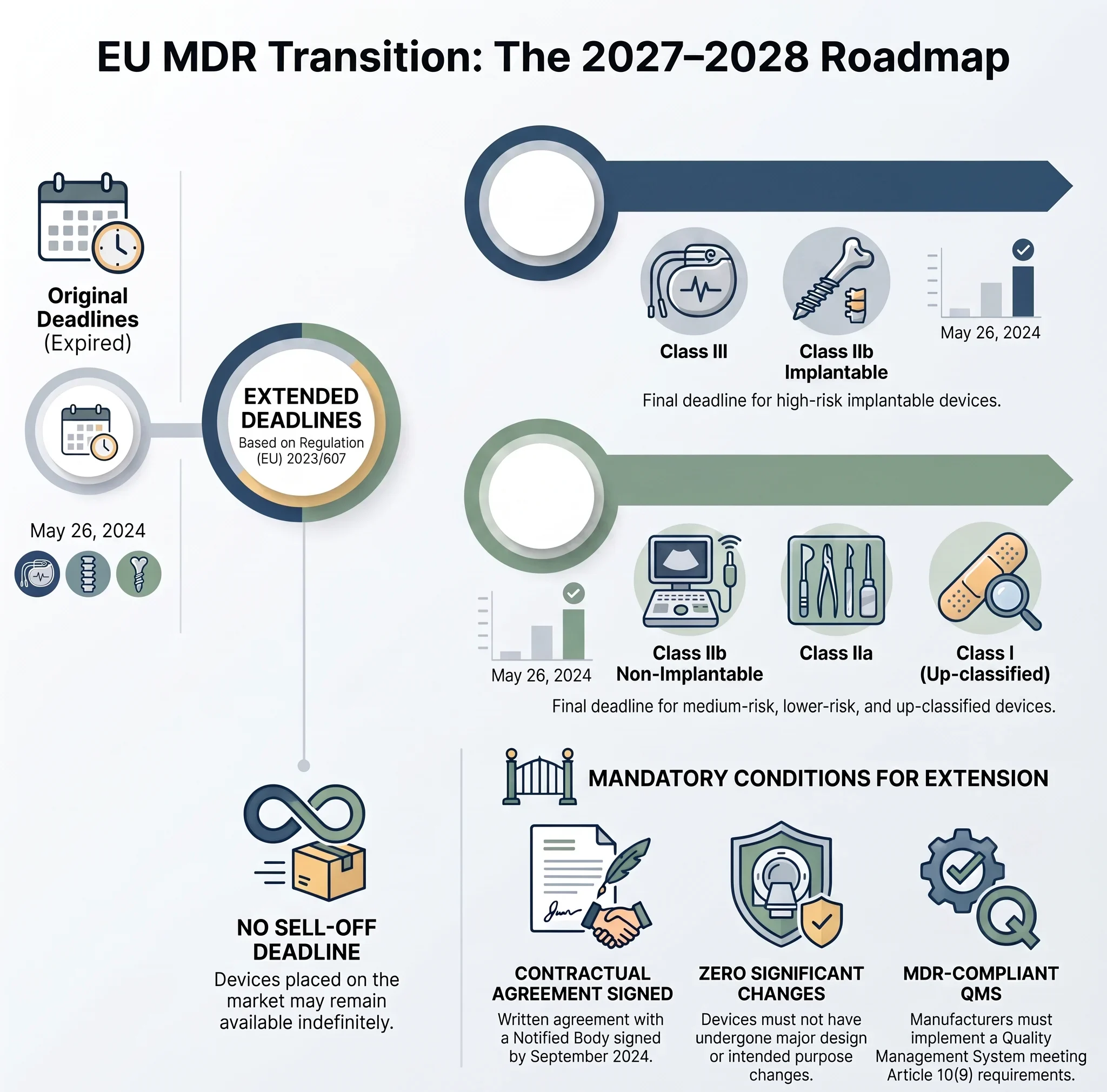
The Original Transition Timeline (Pre-2023/607)
The MDR became fully applicable on 26 May 2021. The original Article 120 provided:
- Devices with valid MDD/AIMDD certificates: Continue market placement until 26 May 2024
- Legacy devices without a notified body certificate (e.g. certain Class I up-classified devices): Continue until 26 May 2024
- Devices sold before 26 May 2024: Could remain on the market until 26 May 2025 (sell-off deadline)
This timeline created a bottleneck. Notified Bodies faced capacity constraints, and many manufacturers were unable to complete transition before the May 2024 deadline.
Regulation (EU) 2023/607: Extended Timeline
Regulation (EU) 2023/607, adopted in March 2023 and entering into force on 20 March 2023, introduced extended transition periods.
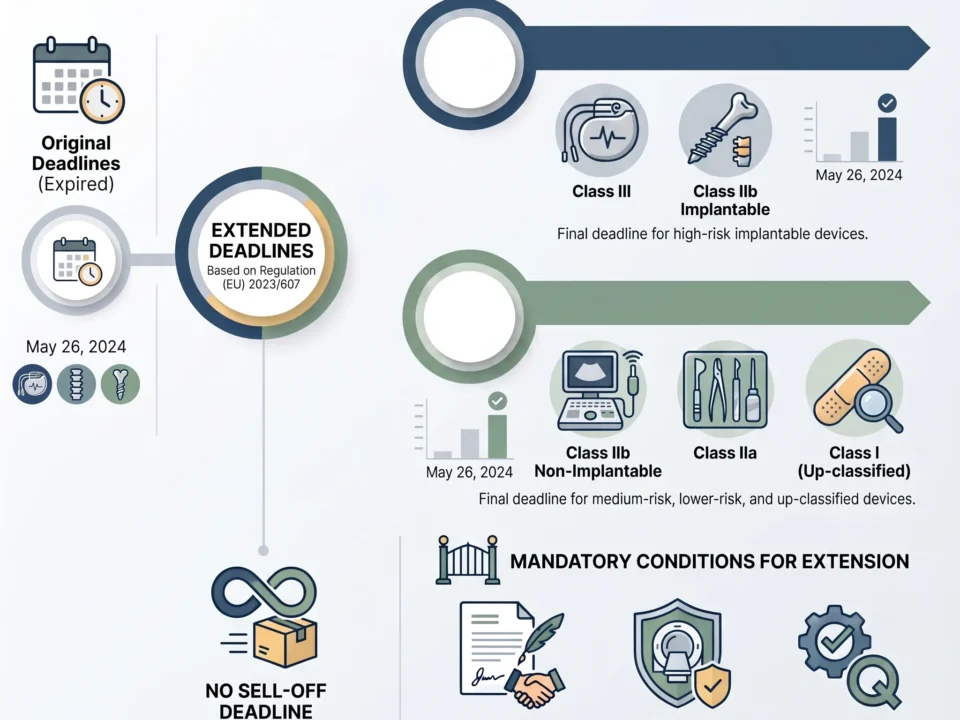
Extended Deadlines
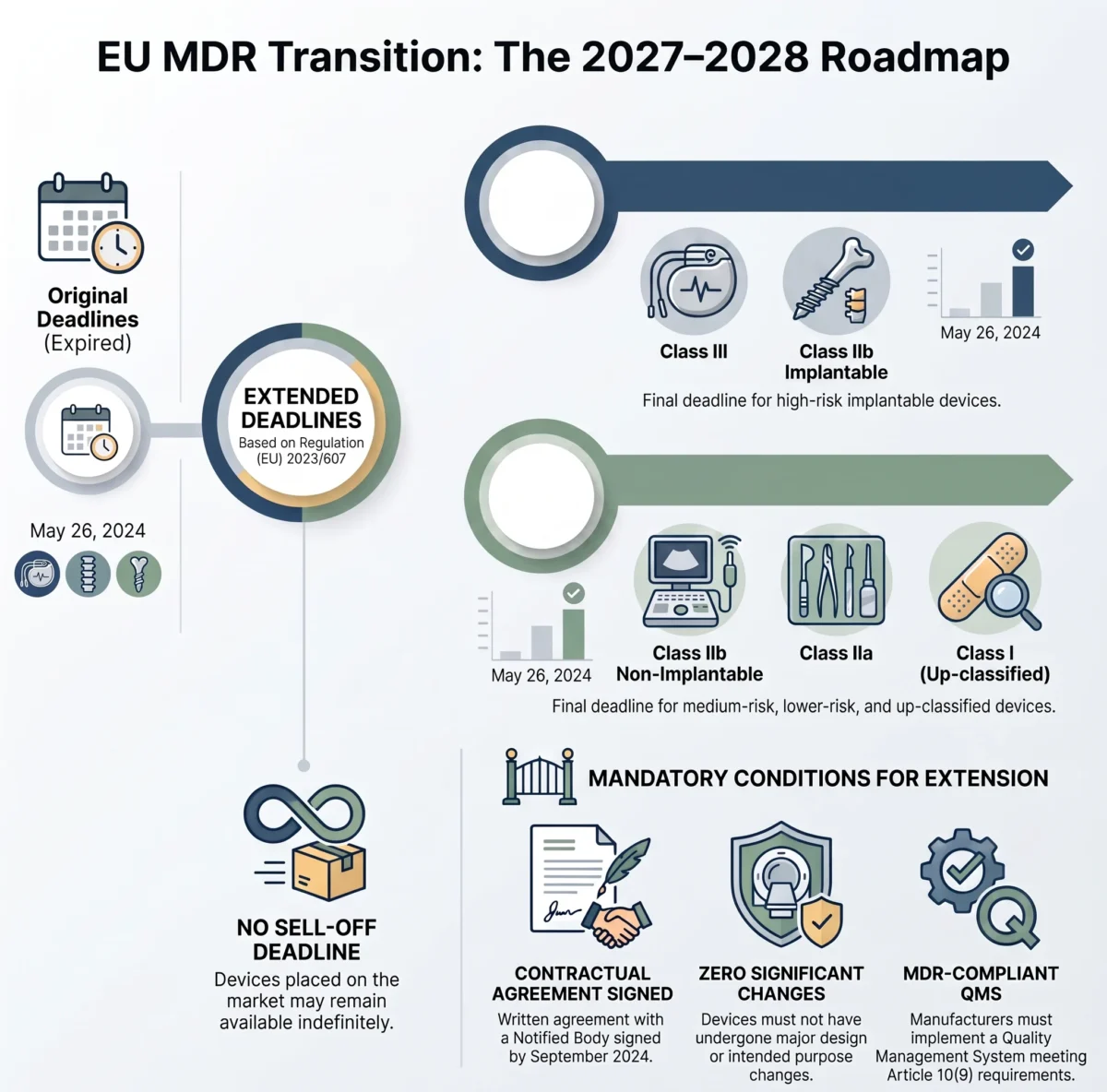
| Device Class | Original Deadline | Extended Deadline (2023/607) |
| Class III and Class IIb implantable (excluding sutures, staples, fillings) | 26 May 2024 | 31 December 2027 |
| Class IIb non-implantable, Class IIa, Class I (sterile/measuring/reusable) | 26 May 2024 | 31 December 2028 |
| Class I up-classified devices without MDD certificate | 26 May 2024 | 31 December 2028 |
Conditions for Extended Deadlines
Manufacturers may benefit from extended deadlines only if ALL conditions are met:
- Valid MDD/AIMDD certificate: The device has a valid certificate issued under MDD or AIMDD that was valid on 26 May 2021 and has not been withdrawn since.If the certificate expired before 20 March 2023, the extension only applies if the manufacturer signed a contract with a Notified Body before the expiry date, or if a Competent Authority granted a derogation under Article 59 or Article 97.
- Contractual agreement: The manufacturer must have lodged a formal application with a Notified Body no later than 26 May 2024, and signed a written agreement no later than 26 September 2024.
- No significant changes: The device has not undergone significant changes in design or intended purpose
- QMS compliance: The manufacturer has an MDR-compliant QMS in accordance with Article 10(9)
Removal of the Sell-Off Deadline
Regulation 2023/607 also removed the sell-off deadline. Devices placed on the market under the extended transition periods may continue to be made available on the market without a fixed sell-off deadline, subject to compliance with applicable requirements. This change has significant implications for inventory management and supply chain planning.
Critical Milestones for MDR Transition Timeline 2025–2028
2025 Milestones
- Ongoing: Notified Body transition audits for devices with extended deadlines
- Ongoing: MDR applications for devices using the 2027/2028 deadlines must be submitted
- May 2026: Five-year anniversary of MDR applicability, first Annex IX certificates approaching renewal (certificates issued May 2021 expire May 2026)
2026 Milestones
- May 2026: First wave of Annex IX certificate renewals (certificates issued in May 2021)
- Ongoing: Last opportunity for manufacturers of class III and IIb implantable devices to begin transition if they wish to use the full December 2027 deadline
- Ongoing: Notified Body capacity remains a critical constraint
2027 Milestones
- 31 December 2027: Final deadline for placing class III and class IIb implantable devices on the market under extended transition provisions
- After this date, only MDR-certified devices may be placed on the market for these classes
- Early 2027: Manufacturers of class IIb non-implantable and class IIa devices should have transition audits in progress
2028 Milestones
- 31 December 2028: Final deadline for placing all remaining legacy devices on the market under extended transition provisions
- After this date, ALL medical devices placed on the EU market must be fully MDR compliant
- No further extensions are currently foreseen
Transition Strategy by Device Class
Class III and Class IIb Implantable Devices (Deadline: December 2027)
These devices face the earliest deadline and the most stringent MDR requirements. Strategy recommendations:
- Immediate action: Ensure your formal application was lodged by 26 May 2024 and the written agreement was signed by 26 September 2024. If these deadlines were missed, the extended transition periods do not apply, and you must seek full MDR certification as a new device or explore Article 97 derogation pathways.
- Clinical evaluation priority: Class III and implantable devices generally require clinical investigations unless sufficient existing clinical data justifies otherwise (Article 61(4))
- Technical documentation upgrade: MDD technical documentation must be upgraded to MDR Annex II and III standards, including expanded clinical evaluation, risk management, and PMS documentation
- QMS upgrade: Ensure the QMS meets MDR requirements, including PRRC designation, PMS system, and UDI implementation
Class IIb Non-Implantable and Class IIa Devices (Deadline: December 2028)
These devices have an additional year. However, with Notified Body capacity constraints, early preparation is essential:
- Notified Body engagement: Approach Notified Bodies early. Some are prioritising class III devices, which may delay class IIb/IIa scheduling
- Gap analysis: Conduct a thorough gap analysis between current MDD certification and MDR requirements
- Clinical evaluation: For class IIb devices, ensure equivalence claims under MDCG 2020-5 are robust or plan for own clinical data
- PMS/PMCF: Implement the full PMS system including PSUR and PMCF Plan before transition audit
Class I Devices (Up-Classified Under MDR)
Many devices that were class I under MDD have been up-classified to IIa or higher under MDR. These devices did not require Notified Body involvement under MDD but now do. Strategy:
- Reclassification review: Confirm the MDR classification for all devices that were self-declared as class I under MDD
- Notified Body selection: First-time engagement with a Notified Body requires additional lead time
- Technical documentation: Full technical documentation must be prepared, these devices have no existing Notified Body-reviewed documentation
Notified Body Capacity
Notified Body capacity has been and remains the single greatest bottleneck in the MDR transition timeline. Currently:
- Over 40 Notified Bodies designated under MDR (compared to over 80 under MDD)
- Several major Notified Bodies have left the market
- Class III devices are prioritised by most Notified Bodies
- Lead times for initial audit scheduling range from 6 to 18 months depending on device class and Notified Body
Manufacturers should:
- Contact multiple Notified Bodies to compare availability
- Prepare all documentation before submitting the application
- Consider the Notified Body Selection MDR criteria when choosing a partner
Consequences of Missing Transition Deadlines
If the MDR Transition Timeline 2025–2028 deadlines are missed:
- Devices cannot be legally placed on the EU market
- Existing MDD certificates expire without replacement
- Inventory in the supply chain may be affected (though the sell-off deadline removal helps)
- Competent authorities may take enforcement action
- Market share may be lost to competitors who have transitioned
Summary
The MDR Transition Timeline 2025–2028 provides extended deadlines under Regulation 2023/607, but manufacturers must act proactively:
- Dec 2027: Class III and IIb implantable device deadline
- Dec 2028: All other legacy device deadline
- Transition contracts must be signed with Notified Bodies
- Technical documentation, clinical evaluation, and QMS must be upgraded
- Notified Body capacity is the critical path, engage early
External resources:
- EUR-Lex Regulation (EU) 2023/607
- European Commission MDR Transition Guidance
- MDCG 2022-4 Transition Guidance
- NANDO Notified Body Database
Contact our team for transition support →
Frequently Asked Questions (FAQ)
What are the extended MDR transition deadlines under Regulation 2023/607?
Regulation 2023/607 extended the transition deadlines to 31 December 2027 for class III and class IIb implantable devices, and to 31 December 2028 for class IIb non-implantable, class IIa, and up-classified class I devices. These extensions apply only if manufacturers meet all conditionsincluding having lodged a formal application by 26 May 2024 and signed a written agreement by 26 September 2024.
What conditions must manufacturers meet for deadline extensions?
Manufacturers must have a valid MDD or AIMDD certificate that was valid on 26 May 2021, lodged a formal application by 26 May 2024 and signed a written agreement by 26 September 2024, no significant changes to the device design or intended purpose, and a QMS meeting MDR requirements per Article 10(9). All conditions must be satisfied.
Did Regulation 2023/607 remove the sell-off deadline?
Yes, Regulation 2023/607 removed the sell-off deadline entirely for devices placed on the market under the extended transition periods. These devices may continue to be made available without a fixed sell-off deadline, subject to compliance with applicable requirements, which significantly benefits inventory management and supply chain planning for manufacturers transitioning to MDR.
What happens if a manufacturer misses the transition deadlines?
Devices cannot be legally placed on the EU market after their respective deadlines expire. Existing MDD certificates expire without replacement, competent authorities may take enforcement action, and the manufacturer risks losing market share to competitors who completed their transition. The sell-off deadline removal provides some relief for existing inventory already placed on the market.
How should class IIb and IIa manufacturers approach their MDR transition?
These manufacturers should engage with Notified Bodies early due to capacity constraints, conduct a thorough gap analysis between current MDD certification and MDR requirements, ensure robust equivalence claims under MDCG 2020-5 for clinical evaluation, and implement the full PMS system including PSUR and PMCF Plan before their transition audit.